5.NF.A Measuring Cups
Lucy has measuring cups of sizes 1 cup, \(\frac{1}{2}\) cup, \(\frac{1}{3}\) cup, and \(\frac{1}{4}\) cup. She is trying to measure out \(\frac{1}{6}\) of a cup of water and says ''if I fill up the the \(\frac{1}{2}\) cup and then pour that into the \(\frac{1}{3}\) cup until it is full, there will be \(\frac{1}{6}\) of a cup of water left.''
- Is Lucy's method to measure \(\frac{1}{6}\) of a cup of water correct? Explain.
- Lucy wonders what other amounts she can measure. Is it possible for her to measure out \(\frac{1}{12}\) of a cup? Explain.
- What other amounts of water can Lucy measure?
Solutions
-
Lucy starts out with \(\frac{1}{2}\) cup of water in one container and then uses that to fill up the \(\frac{1}{3}\) cup container. This means that there will be \(\frac{1}{2} - \frac{1}{3}\) cups left in the \(\frac{1}{2}\) cup container. We can use 6 as a common denominator to calculate this fraction:
\begin{align} \frac{1}{2} - \frac{1}{3} &= \frac{1}{2} \times \frac{3}{3} - \frac{1}{3} \times \frac{2}{2} \\ &= \frac{3}{6} - \frac{2}{6} \\ &= \frac{1}{6}. \end{align}So there is \(\frac{1}{6}\) of a cup of water left in the \(\frac{1}{2}\) cup container.
Below is a way to picture this
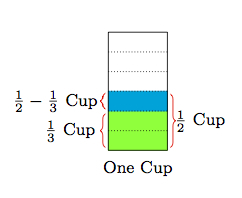
The different measuring cups are not pictured but we can see \(\frac{1}{2}\) of a full cup shaded in both green and blue while \(\frac{1}{3}\) of a cup is shaded in green. So after pouring \(\frac{1}{3}\) of a cup out of the \(\frac{1}{2}\) cup container what will remain is in blue. The full cup is divided into six equal pieces and one of them is blue. This means that $$ \frac{1}{2} - \frac{1}{3} = \frac{1}{6} $$
and \(\frac{1}{6}\) of a cup of water remains in the \(\frac{1}{2}\) cup container.
-
One way Lucy can measure out \(\frac{1}{12}\) of a cup is to follow the same method as in part (a) except this time pour water from the \(\frac{1}{3}\) cup container into the \(\frac{1}{4}\) cup container. Once the smaller container is full, there will be \(\frac{1}{3} - \frac{1}{4}\) cups of water left in the \(\frac{1}{3}\) cup container. We calculate this amount as we did in part (a):
\begin{align} \frac{1}{3} - \frac{1}{4} &= \frac{1}{3} \times \frac{4}{4} - \frac{1}{4} \times \frac{3}{3} \\ &= \frac{4}{12} - \frac{3}{12} \\ &= \frac{1}{12}. \end{align}So there will be \(\frac{1}{12}\) of a cup of water left in the \(\frac{1}{3}\) cup container. This is pictured in two steps below:
With pictures, in order to show both \(\frac{1}{3}\) and \(\frac{1}{4}\) of a cup we draw one cup, divided into 12 equal pieces:
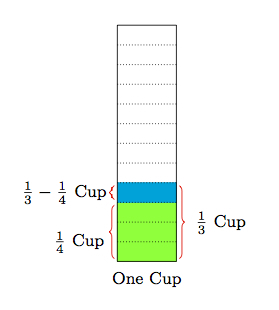
This shows that after pouring \(\frac{1}{4}\) of a cup out of the \(\frac{1}{3}\) cup container, \(\frac{1}{12}\) of a cup will remain.
-
We have seen in parts (a) and (b) that Lucy can measure \(\frac{1}{6} = \frac{2}{12}\) of a cup and also \(\frac{1}{12}\) of a cup. Her three containers measure \(\frac{1}{4} = \frac{3}{12}\) of a cup, \(\frac{1}{3} = \frac{4}{12}\) of a cup, and \(\frac{1}{2} = \frac{6}{12}\) of a cup. For \(\frac{5}{12}\) of a cup, she can measure \(\frac{1}{12}\) of a cup and put this in her \(\frac{1}{2}\) cup container: then she can fill up the \(\frac{1}{3} = \frac{4}{12}\) cup container and add this giving \(\frac{5}{12}\) of a cup. In order to get \(\frac{7}{12}\), \(\frac{8}{12}\), \(\frac{9}{12}\), \(\frac{10}{12}\), \(\frac{11}{12}\), and \(\frac{12}{12}\) of a cup, Lucy can add \(\frac{1}{2} = \frac{6}{12}\) to the one cup container and then measure out the appropriate number of twelfths of a cup (1,2,3,4, 5, or 6) using the other containers and then add this to the one cup container.
Lucy can only measure a whole number of twelfths of a cup--for example, she could measure \(\frac{17}{12} = 1\frac{5}{12}\)--with the cups she has. To see why, notice that each cup measures a whole number of \(\frac{1}{12}\) cups. Pouring water out of one container and into another allows her to add or subtract these amounts. Adding and subtracting a whole number of twelfths will always lead to a whole number of twelfths.
Commentary
This task could form part of a classroom activity where students are encouraged to find as many different ways as possible to make different fractions such as \(\frac{1}{12}\) and then share their methods. While measuring cups would be helpful to experiment with and explore the different possibilities of how to use the cups, students will need to use mathematics in order to calculate the precise amount of water left in any given cup.
The mathematics here is very closely related to work with Egyptian fractions (see for example www.illustrativemathematics.org/illustrations/839). Egyptian fractions, however, are sums of unit fractions while this work with measuring cups gives both sums and differences. Moreover, Lucy can use the same measuring cup multiple times. A different variant on this task, which would capture the spirit of Egyptian fractions, would allow Lucy to use each measuring cup at most a single time.
Work on this task can support many of the standards of mathematical practice including