4.OA Multiples of 3, 6, and 7
- Make a list of the first ten multiples of 3.
- Which of the numbers in your list are multiples of 6? What pattern do you see in where the multiples of 6 appear in the list?
- Which numbers in the list are multiples of 7? Can you predict when multiples of 7 will appear in the list of multiples of 3? Explain your reasoning.
Solutions
-
The first ten multiples of 3 are listed below: $$ 3, 6, 9, 12, 15, 18, 21, 24, 27, 30. $$
-
The multiples of 6 in the list are highlighted in larger, bold face: $$ 3, {\bf{\large 6}}, 9, {\bf{\large 12}}, 15, {\bf{\large 18}}, 21, {\bf{\large 24}}, 27, {\bf{\large 30}}. $$ It appears as if every other number in the sequence is a multiple of 6. In order to see why, here is a picture showing 10 \(\times\) 3:
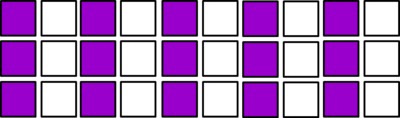
Notice that 2 groups of three make 1 group of six. This can be seen in the picture as 1 group of three purple squares and 1 group of three white squares.
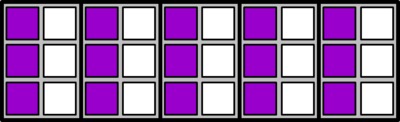
So with an even number of threes, we can group them in pairs to make sixes. When there is an odd number of threes, there are some groups of six with a leftover group of three: in the picture, an odd number of threes leaves a purple group which does not match up with a white group (or vice versa).
-
The only number in the list that is a multiple of 7 is 21 which is \(7 \times 3\). If we write the list of multiples of 7: $$\begin{align} 7, 14, {\bf{\large 21}},& \\ 28, 35, {\bf{\large 42}},& \\ 49, 56, {\bf{\large 63}},& \\ 70, 77, {\bf{\large 84}}& \\ \end{align}$$ and then extend the list of multiples of 3: $$\begin{align} 3, 6, 9, 12, 15, 18, {\bf{\large 21}}, & \\ 24, 27, 30, 33, 36, 39, {\bf{\large 42}}, & \\ 45, 48, 51, 54, 57, 60, {\bf{\large 63}}, & \\ 66, 69, 72, 75, 78, 81, {\bf{\large 84}} \end{align}$$ we can see that the first four multiples of 7 that appear in the list of multiples of 3 are 21, 42, 63, and 84.
21 is \(3\times7\).
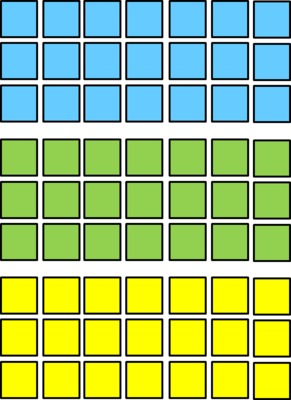
We got 42 as a multiple of 7 because \(42=6\times 7\). We can rewrite it as follows: $$6\times7 = (2\times3)\times7 = 2\times(3\times7) = 2\times 21$$ This is the same as 2 groups of 21. The next one they have in common is 63, which came from \(9\times7\). As before, we can see that this is a multiple of 21: $$9\times7 = (3\times3)\times7 = 3\times(3\times7) = 3\times 21$$ In general, the multiples of 7 that appear in the list of multiples of 3 are also multiples of 21, and these happen each 7th multiple of 3 because each seven groups of 3 make a multiple of 7.
-
The first ten multiples of 3 are listed below: $$ 3, 6, 9, 12, 15, 18, 21, 24, 27, 30. $$
-
The multiples of 6 in the list are highlighted in larger, bold face: $$ 3, {\bf{\large 6}}, 9, {\bf{\large 12}}, 15, {\bf{\large 18}}, 21, {\bf{\large 24}}, 27, {\bf{\large 30}}. $$ It appears as if every other number in the sequence is a multiple of 6. In order to see if this will continue, note that the multiples of 3 could also be written as $$ 1 \times 3, 2 \times 3, 3 \times 3, 4 \times 3, 5 \times 3, 6 \times 3, 7 \times 3, 8 \times 3, 9 \times 3, 10 \times 3. $$ The even numbers, 2, 4, 6, \(\ldots\) all have a factor of 2 and when this is multiplied by 3 the product has a factor of 6. This explains why the even numbered elements in the sequence are multiples of 6.
Alternatively, using 8 \(\times\) 3 as an example, we can write
\begin{align} 10 \times 3 &= (5 \times 2) \times 3 \\ &= 5 \times (2 \times 3) \\ &= 5 \times 6 \end{align}so that 10 \(\times\) 3 is written as a multiple of 6. The second equation uses the associative property of multiplication. This argument works for any even number in place of 8 because each even number has a factor of 2.
On the other hand, an odd number times an odd number is odd so the 1st, 3rd, 5th, \(\ldots\) elements of this sequence are odd: since 6 is a multiple of 2, any multiple of 6 is also a multiple of 2 and so must be even. This explains why the odd numbered elements of the sequence are not multiples of 6.
-
The only number in the list of multiples of 3 which is also a multiple of 7 is 21 = 3 \(\times\) 7. This is the seventh number in the sequence. We might guess that just as every second number in the sequence is a multiple of 2 so every seventh number in the sequence is a multiple of 7. We can check that this is so by writing equations like in part (b). We use 28 = 4 \(\times\) 7 as an example
\begin{align} 28 \times 3 &= (4 \times 7) \times 3 \\ &= 4 \times (7 \times 3) \\ &= 4 \times 21 \end{align}This reasoning will show that every seventh number in the sequence is a multiple of 21.
Commentary
This task investigates divisibility properties for the numbers 3, 6, and 7. Students first make a list of multiples of 3 and then investigate this list further, looking for multiples of 6 and 7. In addition to noticing that every other multiple of 3 is a multiple of 6, students will see that all multiples of 6 are also multiples of 3 because 3 is a factor of 6. Because the list of multiples of 3 is only long enough to show one multiple of 7, students will have to either continue the list or generalize based upon their observations from part (b). Unlike 6, there is no factor of 3 in 7 and so not every multiple of 7 has a factor of 3: in order to be a multiple of both 3 and 7, a number must be a multiple of 21.
One important difference in the multiples of 6 and 7 that appear in the list of multiples of 3 is that every multiple of 6 is also a multiple of 3. So 6, 12, 18, \(\ldots\) all appear in the list of multiples of 3. Since 3 is not a factor of 7, not every multiple of 7 occurs in the list of multiples of 3. The teacher may wish to direct or ask the students about this key difference in the multiples of 6 and 7 which are also multiples of 3. The first solution also refers to the fact that an odd number times an odd number is odd and the teacher may wish to go into this in greater depth as it is another good example of a pattern exemplifying 4.OA.5.
This task will engage students in MP7, look for and make use of structure, and MP8, look for and express regularity in repeated reasoning (MP8). For part (b) students can use their list to observe and then generalize the pattern while part (c) requires understanding how to extend the reasoning for part (b).
Students would benefit from having access to \(\frac14\)-inch graph paper and colored pencils for this task. The first solution shows some pictures that students could easily generate with those tools.