1.OA 20 Tickets
Materials
- 20 counters or linking cubes per pair of students
- pencil
- copy of the problem
Actions
The teacher poses the problem:
Bo bought 20 tickets to play games at Family Fun Night at his school. He wants to play each game at least once. He needs to use all of his tickets. How many times might he play each game? Find at least two ways he can do it.
| Game | Number of Tickets Needed |
|---|---|
| Ring Toss | 1 |
| Putt-Putt Golf | 2 |
| Soccer Kick | 3 |
| Moonwalk | 5 |
When all pairs of students have had a chance to find at least one solution, the teacher can lead a whole-group discussion and record each solution as an equation on chart paper or the chalkboard/whiteboard/SmartBoard.
Solutions
One solution is:
- 1 ring toss
- 3 Putt Putt Golf
- 1 Soccer Kick
- 2 Moonwalks
Students can use linking cubes or counters to represent the required tickets.
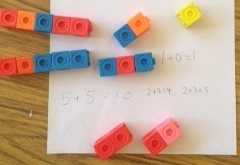
One equation that represents this is
$$1+0+5+5+2+3+2+2=20$$
Some students might also record their thinking using equations:
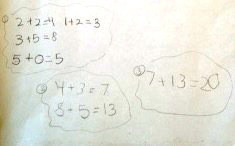
Another equation that represents this is
$$2+2+1+2+3+5+5+0=20$$
First, play each game once:
$$1+2+3+5=11$$
11 tickets are used. 20 - 11 = 9, so there are 9 tickets left.
One way to use the rest of the tickets is to play Ring Toss, Soccer Kick and Moonwalk again because $$1+3+5= 9$$
- Ring Toss: 2
- Putt-Putt Golf: 1
- Soccer Kick: 2
- Moonwalk: 2
We can write this solution as an equation in different ways:
$$1+1+2+3+3+5+5=20$$ or $$1+2+3+5+1+3+5=20$$ or $$2+2+6+10=21$$
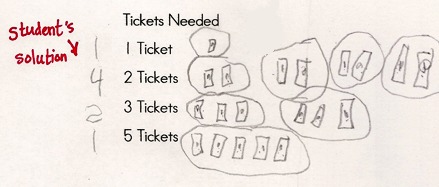
An equation that represents this solution is $$1 + 2+2+2+2+3+3+5=20$$
Commentary
The purpose of the task is for students to add and subtract within 20 (1.OA.1) and represent complex addition problems with an equation to increase their understanding of and flexibility with the equals sign (1.OA.7). There are multiple solutions, and each pair of students should find more than one. The students can use the counters or linking cubes to represent each ticket needed to do each game, but then they should be encouraged to draw a picture to represent their work so there is a record of their thought process. Students who are comfortable with symbolic representations can record their solutions using equations.
The problem can be differentiated by using either a smaller or larger number of tickets. An extension would also be to have the students find the greatest number of times the games could be played to still do all games at least once. Another would be to ask if they can play each game twice and justify their thinking and solution.
The solutions shown below are based on actual student solutions.