2.OA Red and Blue Tiles
Lin wants to put some red and blue tiles on a wall for decoration. She is thinking about several different patterns of tiles she could create. She wants to choose a pattern that would let her use exactly as many red tiles as blue tiles.
-
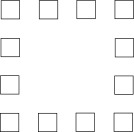
Is it possible to create the pattern below using the same number of red tiles as blue tiles? Explain.
-
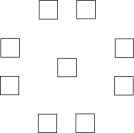
Is it possible to create the pattern below using the same number of red tiles as blue tiles? Explain.
-
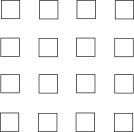
Can you figure out how many tiles are in the pattern below without counting them one by one? Is it possible to create this pattern using the same number of red tiles as blue tiles? Explain.
-
Of the patterns above, which ones have an even number of tiles? Which ones have an odd number of tiles? If Lin wants to use an equal number of red tiles and blue tiles, should she use a pattern with an even number of tiles, or one with an odd number of tiles? Explain.
Solutions
This solution uses the language of even and odd even though the task statement does not. For students who are already familiar with that terminology, it would be great if they recognize that it is appropriate here and use it. For students who are not familiar with it, this task provides a great opportunity for teachers to introduce it.
The first arrangement can be divided into two equal parts; for example, we can divide the pattern into the top half and the bottom half. This means that the number of tiles in this arrangement is even.
If we try pairing tiles in the second seating arrangement, we end up with one tile left over. Therefore, the number of tiles in this arrangement is odd.
The tiles in this arrangement are in a 4-by-4 array, so the total number of tiles is 4 + 4 + 4 + 4 = 16. Again, we can divide this arrangement into a top half and a bottom half, so the number of tiles is even.
When the number of tiles is even, Leslie can divide the tiles into two equal-sized groups, one to be made of red tiles and one to be made of blue tiles. She can then create the pattern using an equal number of tiles of each color. When the number of tiles is odd, there will have to be a color (red or blue) that has at least one more tile than the other color. Therefore, Leslie should use a pattern with an even number of tiles if she wants to use the same number of red and blue tiles.
Commentary
An even number is an integer that is a multiple of 2 while an odd number is an integer that isn't even. In second grade students have not yet learned about multiplication and division (much less factors and multiples), so standard 2.OA.3 calls for students to determine whether a set of objects contains an even or odd number of members using strategies that reflect a grade-appropriate understanding of even and odd. These strategies, such as pairing objects or attempting to divide the objects into two equal subgroups correspond to the "number of groups unknown" and "group size unknown" interpretations of division by 2 that students will study in more depth in third grade.
This task is specifically written so that students have opportunities to use different strategies to determine whether a set has an even or odd number of objects. In particular, part (b) invites students to pair tiles until it is clear that one unpaired tile is left over. Students may suggest using a half of a blue tile and half of a red tile; the teacher should acknowledge that this works if the tiles can be easily broken into two pieces but wouldn't work if not.
In part (c) the tiling arrangement could easily be divided into two equal parts (e.g., the top half and the bottom half). It would be a good idea for the teacher to draw attention to these two different strategies when they are used by the students. In addition, part (c) asks students to determine the number of tiles in an array without counting each tile individually. This can be accomplished using repeated addition, as suggested by 2.OA.4. This foreshadows the introduction of multiplication in third grade.
The reading level for this task may be above that of many second graders, so it is likely that the teacher will need to verbally introduce the task to the students. The figures are intentionally drawn so that students can color the tiles, so it would be good to have red and blue crayons or pencils on hand.