Sum and Difference Formulas
Article objectives
In this article, we will derive identities for the trigonometric functions of the sum and difference of two angles. For the sum of any two angles A and B, we have the addition formulas:
$$sin (A+B) = sin A cos B + cos A sin B \;\;\;\; (1)$$ $$cos (A+B) = cos A cos B − sin A sin B \;\;\;\; (2)$$
To prove these, first assume that A and B are acute angles. Then A+B is either acute or obtuse, as in Figures 1 and 2. Note in both cases that \(\angle\)QPR = A, since $$\angle{QPR} = \angle{QPO}−\angle{OPM} = (90º −B)−(90º −(A+B)) = A \text{in Figure 1, and}$$ $$\angle{QPR} = \angle{QPO}+\angle{OPM} = (90º −B)+(90º −(180º −(A+B))) = A \text{in Figure 2.}$$
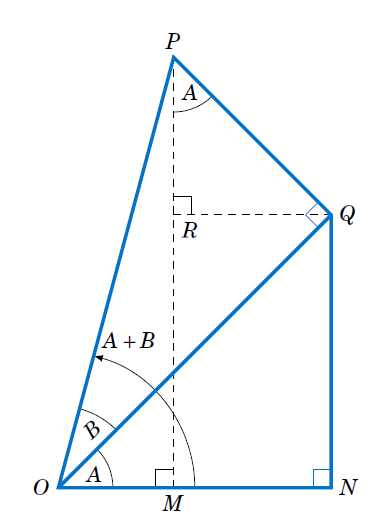
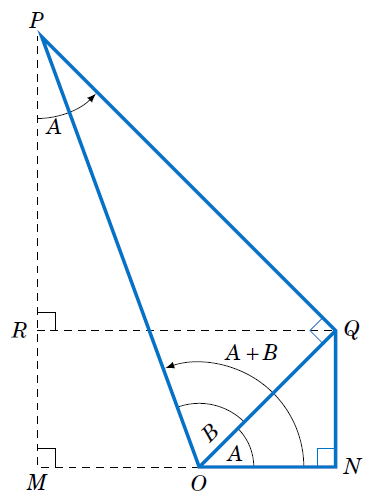
Thus, $$sin (A+B) = \frac{MP}{ OP} = \frac{MR+RP}{ OP} = \frac{NQ+RP}{ OP} = \frac{NQ}{ OP} + \frac{RP}{ OP}$$ $$= \frac{NQ}{ OQ} • \frac{OQ}{ OP} + \frac{RP}{ PQ} • \frac{PQ}{ OP}$$ $$= sin A cos B + cos A sin B , \;\;\;\; (3)$$
and
$$cos (A+B) = \frac{OM}{ OP} = \frac{ON −MN}{ OP} = \frac{ON −RQ}{ OP} = \frac{ON}{ OP} −\frac{ RQ}{ OP}$$ $$= \frac{ON}{ OQ} • \frac{OQ}{OP} + \frac{RQ}{ PQ} •\frac{ PQ}{ OP}$$ $$= cos A cos B − sin A sin B . \;\;\;\; (4)$$
So we have proved the identities for acute angles A and B. It is simple to verify that they hold in the special case of A = B = 0º. For general angles, we will need to use the relations involving adding or subtracting 90º:
| $$sin (θ+90º) = cos θ$$ | $$sin (θ−90º) = −cos θ$$ |
| $$cos (θ+90º) = −sin θ$$ | $$cos (θ−90º) = sin θ$$ |
These will be useful because any angle can be written as the sum of an acute angle (or 0º) and integer multiples of ±90º. For example, 155º = 65º +90º, 222º = 42º +2(90º), −77º = 13º −90º, etc. So if we can prove that the identities hold when adding or subtracting 90º to or from either A or B, respectively, where A and B are acute or 0º, then the identities will also hold when repeatedly adding or subtracting 90º, and hence will hold for all angles. Replacing A by A+90º and using the relations for adding 90º gives
$$sin ((A+90º)+B) = sin ((A+B)+90º) = cos (A+B) ,$$ $$= cos A cos B − sin A sin B \text{(by equation 4)}$$ $$= sin (A+90º) cos B + cos (A+90º) sin B ,$$
so the identity holds for A+90º and B (and, similarly, for A and B+90º). Likewise,
$$sin ((A−90º)+B) = sin ((A+B)−90º) = −cos (A+B) ,$$ $$= −(cos A cos B − sin A sin B)$$ $$= (−cos A) cos B + sin A sin B$$ $$= sin (A−90º) cos B + cos (A−90º) sin B ,$$
so the identity holds for A−90º and B (and, similarly, for A and B+90º). Thus, the addition formula 1 for sine holds for all A and B. A similar argument shows that the addition formula 2 for cosine is true for all A and B. Replacing B by −B in the addition formulas and using the relations sin (−θ) = −sin θ and cos (−θ) = cos θ gives us the subtraction formulas:
$$sin (A−B) = sin A cos B − cos A sin B \;\;\;\; (5)$$ $$cos (A−B) = cos A cos B + sin A sin B \;\;\;\; (6)$$
Using the identity tan θ = \(\frac{sin θ}{ cos θ}\) , and the addition formulas for sine and cosine, we can derive the addition formula for tangent:
$$tan (A+B) = \frac{sin (A+B)}{ cos (A+B)}$$ $$= \frac{sin A cos B + cos A sin B}{ cos A cos B − sin A sin B}$$ $$= \frac{\frac{sin A cos B}{ cos A cos B} + \frac{cos A sin B}{ cos A cos B}}{\frac{ cos A cos B}{ cos A cos B} − \frac{sin A sin B}{ cos A cos B}} \text{(divide top and bottom by cos A cos B)}$$ $$\frac{\frac{sin A}{ cos A} • \frac{cos B}{ cos B} + \frac{ cos A}{ cos A} • \frac{sin B}{ cos B}}{ 1 − \frac{sin A}{ cos A} • \frac{sin B}{ cos B}} = \frac{tan A + tan B}{ 1 − tan A tan B}$$
This, combined with replacing B by −B and using the relation tan (−θ) = −tan θ, gives us the addition and subtraction formulas for tangent:
$$tan (A+B) = \frac{tan A + tan B}{ 1 − tan A tan B} \;\;\;\; (7)$$ $$tan (A−B) = \frac{tan A − tan B}{ 1 + tan A tan B} \;\;\;\; (8)$$
The sum formulas for sine and cosine allow us to derive two other formulas relatively quickly. These derivations will be the first two examples.
Example 1: Use the angle addition formula for the sine function to expand \(\sin(2x)\).
Solution: Rewrite the expression as \(\sin(x + x)\). The angle addition formula allows this to be expanded as follows:
$$\sin(x + x) = \sin(x)\cos(x) + \cos(x)\sin(x) = 2\sin(x)\cos(x)$$
Example 2: Use the angle addition formula for cosine to expand \(\cos(2x)\).
Solution: Just like the procedure used in Example 1, rewrite the expression as \(\cos(x + x)\). Expand this with the angle addition formula for cosine:
$$\cos(x + x) = \cos(x)\cos(x) - \sin(x)\sin(x) = \cos(x)^2 - \sin(x)^2$$
Example 3:
Given angles A and B such that sin A = \(\frac{4}{ 5}\) , cos A = \(\frac{3}{ 5}\) , sin B = \(\frac{12}{ 13}\) , and cos B = \(\frac{5}{ 13}\) , find the exact values of sin (A+B), cos (A+B), and tan (A+B).
Solution: Using the addition formula for sine, we get:
$$sin (A+B) = sin A cos B + cos A sin B$$ $$= \frac{4}{ 5} •\frac{ 5}{ 13} + \frac{3}{ 5} • \frac{12}{ 13} ⇒ \boxed{sin (A+B) = \frac{56}{ 65}}$$
Using the addition formula for cosine, we get:
$$cos (A+B) = cos A cos B − sin A sin B$$ $$= \frac{3}{ 5} • \frac{5}{ 13} − \frac{4}{ 5} • \frac{12}{ 13} ⇒ \boxed{cos (A+B) = − \frac{33}{ 65}}$$
Instead of using the addition formula for tangent, we can use the results above:
$$tan (A+B) = \frac{sin (A+B)}{ cos (A+B)} = \frac{56}{ 65} −\frac{33}{ 65} ⇒ \boxed{tan (A+B) = − \frac{56}{ 33}}$$
Example 4:
Prove the following identity: sin (A+B+C) = sin A cos B cos C + cos A sin B cos C + cos A cos B sin C − sin A sin B sin C
Solution: Treat A+B+C as (A+B)+C and use the addition formulas three times: $$sin (A+B+C) = sin ((A+B)+C)$$ $$= sin (A+B) cos C + cos (A+B) sin C$$ $$= (sin A cos B + cos A sin B) cos C + (cos A cos B − sin A sin B) sin C$$ $$= sin A cos B cos C + cos A sin B cos C + cos A cos B sin C − sin A sin B sin C$$
Example 5:
For any triangle △ABC, show that tan A+tan B+tan C = tan A tan B tan C.
Solution: Note that this is not an identity which holds for all angles; since A, B, and C are the angles of a triangle, it holds when A, B, C > 0º and A+B+C = 180º. So using C = 180º −(A+B) and the relation tan (180º −θ) = −tan θ, we get: $$tan A + tan B + tan C = tan A + tan B + tan (180º −(A+B))$$ $$= tan A + tan B − tan (A+B)$$ $$= tan A + tan B − \frac{tan A+tan B}{ 1−tan A tan B}$$ $$= (tan A + tan B) ( 1 − \frac{1}{ 1−tan A tan B})$$ $$= (tan A + tan B) ( \frac{1−tan A tan B}{ 1−tan A tan B} − \frac{1}{ 1−tan A tan B})$$ $$= (tan A + tan B) • ( \frac{−tan A tan B}{ 1−tan A tan B})$$ $$= tan A tan B • ( − \frac{tan A + tan B}{ 1−tan A tan B})$$ $$= tan A tan B • (−tan (A+B))$$ $$= tan A tan B • (tan (180º −(A+B)))$$ $$= tan A tan B tan C$$
Example 6:
Let A, B, C, and D be positive angles such that A+B+C+D = 180º. Show that $$sin A sin B + sin C sin D = sin (A+C) sin (B+C) .$$
Solution: It may be tempting to expand the right side, since it appears more complicated. However, notice that the right side has no D term. So instead, we will expand the left side, since we can eliminate the D term on that side by using D = 180º −(A+B+C) and the relation
$$sin (180º −(A+B+C)) = sin (A+B+C).$$
So since sin D = sin (A+B+C), we get
$$sin A sin B + sin C sin D = sin A sin B + sin C sin (A+B+C) , \text{so by Example 2 we get}$$ $$= sin A sin B + sin C (sin A cos B cos C + cos A sin B cos C + cos A cos B sin C − sin A sin B sin C)$$ $$= sin A sin B + sin C sin A cos B cos C + sin C cos A sin B cos C + sin C cos A cos B sin C − sin C sin A sin B sin C .$$
It may not be immediately obvious where to go from here, but it is not completely guesswork. We need to end up with sin (A+C) sin (B+C), and we know that sin (B+C) = sin B cos C+cos B sin C. There are two terms involving cos B sin C, so group them together to get
$$sin A sin B + sin C sin D = sin A sin B − sin C sin A sin B sin C + sin C cos A sin B cos C + cos B sin C (sin A cos C + cos A sin C)$$ $$= sin A sin B (1−sin^2 C) + sin C cos A sin B cos C + cos B sin C sin (A+C)$$ $$= sin A sin B cos^2 C + sin C cos A sin B cos C + cos B sin C sin (A+C) .$$
We now have two terms involving sin B cos C, which we can factor out: $$sin A sin B + sin C sin D = sin B cos C (sin A cos C+cos A sin C ) + cos B sin C sin (A+C)$$ $$= sin B cos C sin (A+C) + cos B sin C sin (A+C)$$ $$= sin (A+C) (sin B cos C+cos B sin C)$$ $$= sin (A+C) sin (B+C)$$
Example 7:
In the study of the propagation of electromagnetic waves, Snell’s law gives the relation
$$n_1 sin θ_1 = n_2 sin θ_2 \;\;\;\; (9)$$
where \(θ_{1}\) is the angle of incidence at which a wave strikes the planar boundary between two mediums, \(θ_{2}\) is the angle of transmission of the wave through the new medium, and \(n_{1}\) and \(n_{2}\) are the indexes of refraction of the two mediums. The quantity
$$r_{1 2 s} = \frac{n_1 cos θ_1 − n_2 cos θ_2}{ n_1 cos θ_1 + n_2 cos θ_2} \;\;\;\; (10)$$
is called the Fresnel coefficient for normal incidence reflection of the wave for s-polarization. Show that this can be written as:
$$r_{1 2 s} = \frac{sin (θ_2 −θ_1) }{sin (θ_2 +θ_1)}$$
Solution: Multiply the top and bottom of \(r_{1 2 s}\) by sin \(θ_{1}\) sin \(θ_{2}\) to get:
$$r_{1 2 s }= \frac{n_1 cos θ_1 − n_2 cos θ_2 }{n_1 cos θ_1 + n_2 cos θ_2} •\frac{ sin θ_1 sin θ_2 }{sin θ_1 sin θ_2}$$ $$= \frac{(n_1 sin θ_1) sin θ_2 cos θ_1 − (n_2 sin θ_2) cos θ_2 sin θ_1}{ (n_1 sin θ_1) sin θ_2 cos θ_1 + (n_2 sin θ_2) cos θ_2 sin θ_1}$$ $$= \frac{(n_1 sin θ_1) sin θ_2 cos θ_1 − (n_1 sin θ_1) cos θ_2 sin θ_1}{ (n_1 sin θ_1) sin θ_2 cos θ_1 + (n_1 sin θ_1) cos θ_2 sin θ_1} \text{(by Snell’s law)}$$ $$= \frac{sin θ_2 cos θ_1 − cos θ_2 sin θ_1}{ sin θ_2 cos θ_1 + cos θ_2 sin θ_1}$$ $$= \frac{sin (θ_2 −θ_1)}{ sin (θ_2 +θ_1)}$$
The last two examples demonstrate an important aspect of how identities are used in practice: recognizing terms which are part of known identities, so that they can be factored out. This is a common technique.