Solving Trigonometric Equations
Article objectives
An equation involving trigonometric functions is called a trigonometric equation. For example, an equation like
$$\text{tan } A = 0.75,$$
is a trigonometric equation. In this section we will be concerned with finding the most general solution to such equations.
To see what that means, take the above equation tan A = 0.75. Using the \(\boxed{tan^{−1}}\) calculator button in degree mode, we get A = 36.87º. However, we know that the tangent function has period π rad = 180º, i.e. it repeats every 180º. Thus, there are many other possible answers for the value of A, namely 36.87º+180º, 36.87º−180º, 36.87º+360º, 36.87º−360º, 36.87º +540º, etc. We can write this in a more compact form:
$$A = 36.87^\circ + 180^\circ k \text{ for } k = 0, ±1, ±2, ...$$
This is the most general solution to the equation. Often the part that says “for k = 0, ±1, ±2, ...” is omitted since it is usually understood that k varies over all integers. The general solution in radians would be:
$$A = 0.6435 + πk \text{ for } k = 0, ±1, ±2, ...$$
Example 1
Solve the equation 2 sin θ + 1 = 0.
Solution: Isolating sin θ gives sin θ = −\(\frac{1}{2}\). Using the \(\boxed{sin^{−1}}\) calculator button in degree mode gives us θ = −30º, which is in QIV. Recall that the reflection of this angle around the y-axis into QIII also has the same sine. That is, sin 210º = −\(\frac{1}{2}\). Thus, since the sine function has period 2π rad = 360º, and since −30º does not differ from 210º by an integer multiple of 360º, the general solution is:
$$\boxed{θ = −30º + 360^\circ k \text{ and } 210º + 360^\circ k} \text{ for } k = 0, ±1, ±2, ...$$
In radians, the solution is:
$$\boxed{θ = −\frac{π}{6} + 2πk \text{ and } \frac{7π}{6} +2πk} \text{ for } k = 0, ±1, ±2, ...$$
For the rest of this section we will write our solutions in radians.
Example 2
Solve the equation 2cos2 θ − 1 = 0.
Solution: Isolating cos2 θ gives us
$$cos^2 θ = \frac{1}{2} ⇒ cos θ = ± \frac{1}{\sqrt{2}} ⇒ θ = \frac{π}{4}, \frac{3π}{4}, \frac{5π}{4}, \frac{7π}{4},$$
and since the period of cosine is 2π, we would add 2πk to each of those angles to get the general solution. But notice that the above angles differ by multiples of \(\frac{π}{2}\). So since every multiple of 2π is also a multiple of \(\frac{π}{2}\), we can combine those four separate answers into one:
$$\boxed{θ = \frac{π}{4} + \frac{π}{2} k} \text{ for } k = 0, ±1, ±2, ...$$
Example 3
Solve the equation 2 sec θ = 1.
Solution: Isolating sec θ gives us
$$sec θ = \frac{1}{2} ⇒ cos θ = \frac{1}{sec θ} = 2 ,$$
which is impossible. Thus, there is \(\boxed{\text{no solution}}\).
Example 4
Solve the equation cos θ = tan θ.
Solution: The idea here is to use identities to put everything in terms of a single trigonometric function:
$$cos θ = tan θ$$ $$cos θ = \frac{sin θ}{cos θ}$$ $$cos^2 θ = sin θ$$ $$1 − sin^2 θ = sin θ$$ $$0 = sin^2 θ + sin θ − 1$$
The last equation looks more complicated than the original equation, but notice that it is actually a quadratic equation: making the substitution x = sin θ, we have
$$x^2 + x − 1 = 0 ⇒ x = \frac{−1 ± \sqrt{1−(4) (−1)}}{2(1)} =\frac{−1 ± \sqrt{5}}{2} = −1.618 , 0.618$$
by the quadratic formula from elementary algebra. But −1.618 < −1, so it is impossible that sinθ = x = −1.618. Thus, we must have sin θ = x = 0.618. Hence, there are two possible solutions: θ = 0.666 rad in QI and its reflection π−θ = 2.475 rad around the y-axis in QII. Adding multiples of 2π to these gives us the general solution:
$$\boxed{θ = 0.666 + 2πk \text{ and } 2.475 + 2πk} \text{ for } k = 0, ±1, ±2, ...$$
Example 5
Solve the equation sin θ = tan θ.
Solution: Trying the same method as in the previous example, we get
$$sin θ = tan θ$$ $$sin θ = \frac{sin θ}{cos θ}$$ $$sin θ cos θ = sin θ$$ $$sin θ cos θ − sin θ = 0$$ $$sin θ (cos θ − 1) = 0$$ $$⇒ sin θ = 0 \; \text{ or } \; cos θ = 1$$ $$⇒ θ = 0 , π \; \text{ or } \; θ = 0$$ $$⇒ θ = 0 , π ,$$
plus multiples of 2π. So since the above angles are multiples of π, and every multiple of 2π is a multiple of π, we can combine the two answers into one for the general solution:
$$\boxed{θ = πk} \; \text{ for } \; k = 0, ±1, ±2, ...$$
Example 6
Solve the equation cos 3θ = \(\frac{1}{2}\).
Solution: The idea here is to solve for 3θ first, using the most general solution, and then divide that solution by 3. So since \(cos^{−1} \frac{1}{2} = \frac{π}{3}\), there are two possible solutions for 3θ: 3θ = \(\frac{π}{3}\) in QI and its reflection −3θ = −\(\frac{π}{3}) around the x-axis in QIV. Adding multiples of 2π to these gives us:
$$3θ = ± \frac{π}{3} + 2πk \text{ for } k = 0, ±1, ±2, ...$$
So dividing everything by 3 we get the general solution for θ:
$$\boxed{θ = ± \frac{π}{9} + \frac{2π}{3} k} \text{ for } k = 0, ±1, ±2, ...$$
Example 7
Solve the equation sin 2θ = sin θ.
Solution: Here we use the double-angle formula for sine:
$$sin 2θ = sin θ$$ $$2 sinθ cos θ = sin θ$$ $$sin θ (2 cos θ − 1) = 0$$ $$⇒ sin θ = 0\text{ or }cos θ = \frac{1}{2}$$ $$⇒ θ = 0 , π\text{ or }θ = ± \frac{π}{3}$$ $$⇒ \boxed{θ = πk\text{ and }± \frac{π}{3} + 2πk} \text{ for } k = 0, ±1, ±2, ...$$
Example 8
Solve the trigonometric equation below in the first quadrant of the unit circle:
$$\frac{\csc 2\theta}{\cos \theta + \sin \theta} = 4\cos \theta - 4\sin \theta$$
Solution: Eliminate the fractions to help in simplification:
$$\csc 2\theta = 4(\cos \theta - \sin \theta)(\cos \theta + \sin \theta)$$
If you look carefully you will realize that the right side is a difference of squares. Expand it:
$$\csc 2\theta = 4(\cos^2 \theta - \sin^2 \theta)$$
That difference of squares is part of a trigonometric identity: $$\cos^2 \theta - \sin^2 \theta = \cos 2\theta,$$ so make this substitution:
$$\csc 2\theta = 4\cos 2\theta$$
Multiply both sides of this equation by the reciprocal of the cosecant function on the left-hand side to get the equation in terms of sines and cosines, i.e. the trigonometric functions most students are the most familiar with:
$$1 = 4\sin 2\theta \cos 2\theta$$
Well, another trigonometric identity can be employed at this point to write this in terms of one trigonometric function: $$\sin 2a\theta = 2\sin a\theta \cos a\theta$$.
Here, the value of the constant is 2. Substitute:
$$1 = 2\sin 4\theta$$
Divide both sides of the equation by 2:
$$\frac{1}{2} = \sin 4\theta$$
Now we can take the arc-sin of this equation and divide by 4. This gives us a lot of different solutions.
$$\theta = \frac{\pi}{24}, \frac{5\pi}{24}, \frac{7\pi}{24}, \frac{11\pi}{24}$$
Understanding the Unit Circle in this last step is helpful since a graphing calculator will not give you all the solutions at once.
Example 9
Solve the equation 2 sin θ − 3 cos θ = 1.
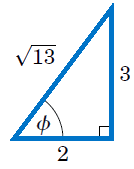
Solution: We will use the technique for finding the amplitude of a combination of sine and cosine functions. Take the coefficients 2 and 3 of sin θ and −cos θ, respectively, in the above equation and make them the legs of a right triangle, as in Figure 1. Let φ be the angle shown in the right triangle. The leg with length 3 > 0 means that the angle φ is above the x-axis, and the leg with length 2 > 0 means that φ is to the right of the y-axis. Hence, φ must be in QI. The hypotenuse has length \(\sqrt{13}\) by the Pythagorean Theorem, and hence cos φ = \(\frac{2}{\sqrt{13}}\) and sin θ = \(\frac{3}{\sqrt{13}}\). We can use this to transform the equation to solve as follows:
$$2 sin θ − 3 cos θ = 1$$ $$\sqrt{13} (\frac{2}{\sqrt{13}} sin θ − \frac{3}{\sqrt{13}} cos θ) = 1$$ $$\sqrt{13} (cos \phi sin θ − sin \phi cos θ) = 1$$ $$\sqrt{13} sin (θ−\phi) = 1 \text{(by the sine subtraction formula)}$$ $$sin (θ−\phi) = \frac{1}{\sqrt{13}}$$ $$⇒ θ−\phi = 0.281\text{ or }θ−\phi = π−0.281 = 2.861$$ $$⇒ θ = \phi + 0.281\text{ or }θ = \phi + 2.861$$
Now, since cos φ = \(\frac{2}{\sqrt{13}}\) and φ is in QI, the most general solution for φ is φ = 0.983+2πk for k = 0, ±1, ±2, ... . So since we needed to add multiples of 2π to the solutions 0.281 and 2.861 anyway, the most general solution for θ is:
$$θ = 0.983 + 0.281 + 2πk\text{ and }0.983 + 2.861 + 2πk$$ $$⇒ \boxed{θ = 1.264 + 2πk\text{ and }3.844 + 2πk}\text{ for }k = 0, ±1, ±2, ...$$
Note: In Example 9 if the equation had been 2 sin θ + 3 cos θ = 1 then we still would have used a right triangle with legs of lengths 2 and 3, but we would have used the sine addition formula instead of the subtraction formula.