Matter as a wave
Article objectives
[In] a few minutes I shall be all melted... I have been wicked in my day, but I never thought a little girl like you would ever be able to melt me and end my wicked deeds. Look out --- here I go! -- The Wicked Witch of the West
As the Wicked Witch learned the hard way, losing molecular cohesion can be unpleasant. That's why we should be very grateful that the concepts of quantum physics apply to matter as well as light. If matter obeyed the laws of classical physics, molecules wouldn't exist.
Consider, for example, the simplest atom, hydrogen. Why does one hydrogen atom form a chemical bond with another hydrogen atom? Roughly speaking, we'd expect a neighboring pair of hydrogen atoms, A and B, to exert no force on each other at all, attractive or repulsive: there are two repulsive interactions (proton A with proton B and electron A with electron B) and two attractive interactions (proton A with electron B and electron A with proton B). Thinking a little more precisely, we should even expect that once the two atoms got close enough, the interaction would be repulsive. For instance, if you squeezed them so close together that the two protons were almost on top of each other, there would be a tremendously strong repulsion between them due to the 1/\(r^2\) nature of the electrical force. The repulsion between the electrons would not be as strong, because each electron ranges over a large area, and is not likely to be found right on top of the other electron. This was only a rough argument based on averages, but the conclusion is validated by a more complete classical analysis: hydrogen molecules should not exist according to classical physics.
Quantum physics to the rescue! As we'll see shortly, the whole problem is solved by applying the same quantum concepts to electrons that we have already used for photons.
Electrons as waves
We started our journey into quantum physics by studying the random behavior of matter in radioactive decay, and then asked how randomness could be linked to the basic laws of nature governing light. The probability interpretation of wave-particle duality was strange and hard to accept, but it provided such a link. It is now natural to ask whether the same explanation could be applied to matter. If the fundamental building block of light, the photon, is a particle as well as a wave, is it possible that the basic units of matter, such as electrons, are waves as well as particles?
A young French aristocrat studying physics, Louis de Broglie (pronounced “broylee”), made exactly this suggestion in his 1923 Ph.D. thesis. His idea had seemed so farfetched that there was serious doubt about whether to grant him the degree. Einstein was asked for his opinion, and with his strong support, de Broglie got his degree.
Only two years later, American physicists C.J. Davisson and L. Germer confirmed de Broglie's idea by accident. They had been studying the scattering of electrons from the surface of a sample of nickel, made of many small crystals. (One can often see such a crystalline pattern on a brass doorknob that has been polished by repeated handling.) An accidental explosion occurred, and when they put their apparatus back together they observed something entirely different: the scattered electrons were now creating an interference pattern! This dramatic proof of the wave nature of matter came about because the nickel sample had been melted by the explosion and then resolidified as a single crystal. The nickel atoms, now nicely arranged in the regular rows and columns of a crystalline lattice, were acting as the lines of a diffraction grating. The new crystal was analogous to the type of ordinary diffraction grating in which the lines are etched on the surface of a mirror (a reflection grating) rather than the kind in which the light passes through the transparent gaps between the lines (a transmission grating).
Although we will concentrate on the wave-particle duality of electrons because it is important in chemistry and the physics of atoms, all the other “particles” of matter you've learned about show wave properties as well. Figure a, for instance, shows a wave interference pattern of neutrons.

Figure a: A double-slit interference pattern made with neutrons. (A. Zeilinger, R. Gähler, C.G. Shull, W. Treimer, and W. Mampe, Reviews of Modern Physics, Vol. 60, 1988.)
It might seem as though all our work was already done for us, and there would be nothing new to understand about electrons: they have the same kind of funny wave-particle duality as photons. That's almost true, but not quite. There are some important ways in which electrons differ significantly from photons:
- Electrons have mass, and photons don't.
- Photons always move at the speed of light, but electrons can move at any speed less than c.
- Photons don't have electric charge, but electrons do, so electric forces can act on them. The most important example is the atom, in which the electrons are held by the electric force of the nucleus.
- Electrons cannot be absorbed or emitted as photons are. Destroying an electron, or creating one out of nothing, would violate conservation of charge.
Because electrons are different from photons, it is not immediately obvious which of the photon equations can be applied to electrons as well. A particle property, the energy of one photon, is related to its wave properties via E=hf or, equivalently, E=hc/λ. The momentum of a photon was given by p=hf/c or p=h/λ. Ultimately it was a matter of experiment to determine which of these equations, if any, would work for electrons, but we can make a quick and dirty guess simply by noting that some of the equations involve c, the speed of light, and some do not. Since c is irrelevant in the case of an electron, we might guess that the equations of general validity are those that do not have c in them:
$$E = hf$$ $$p = \frac{h}{λ}$$
This is essentially the reasoning that de Broglie went through, and experiments have confirmed these two equations for all the fundamental building blocks of light and matter, not just for photons and electrons.
The second equation takes on a greater importance for electrons. This is first of all because the momentum of matter is more likely to be significant than the momentum of light under ordinary conditions, and also because force is the transfer of momentum, and electrons are affected by electrical forces.
Example 1: The wavelength of an elephant
◊ What is the wavelength of a trotting elephant?
◊ One may doubt whether the equation should be applied to an elephant, which is not just a single particle but a rather large collection of them. Throwing caution to the wind, however, we estimate the elephant's mass at \(10^3\) kg and its trotting speed at 10 m/s. Its wavelength is therefore roughly
$$λ=\frac{h}{p}$$ $$=\frac{h}{mv}$$ $$=\frac{6.63\times10^{-34}J\cdot s}{(10^3 kg)(10 m/s)}$$ $$\sim 10^{-37} \frac{(kg \cdot m^2/ s^2)}{kg \cdot m/s}$$ $$=10^{-37} m$$
The wavelength found in this example is so fantastically small that we can be sure we will never observe any measurable wave phenomena with elephants. The result is numerically small because Planck's constant is so small, and as in some examples encountered previously, this smallness is in accord with the correspondence principle.
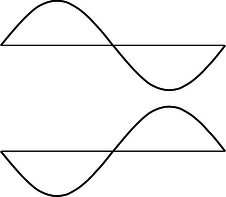
Figure b: These two electron waves are not distinguishable by any measuring device.
Although a smaller mass in the equation λ=h/mv does result in a longer wavelength, the wavelength is still quite short even for individual electrons under typical conditions, as shown in the following example.
Example 2: The typical wavelength of an electron
◊ Electrons in circuits and in atoms are typically moving through voltage differences on the order of 1 V, so that a typical energy is (e)(1 V), which is on the order of \(10^{-19} J\). What is the wavelength of an electron with this amount of kinetic energy?
◊ This energy is nonrelativistic, since it is much less than \(mc^2\). Momentum and energy are therefore related by the nonrelativistic equation \(KE=p^2 /2m\). Solving for p and substituting in to the equation for the wavelength, we find $$λ = \frac{h}{\sqrt{2m \cdot KE}}$$ $$=1.6 \times 10^{-9} m$$
This is on the same order of magnitude as the size of an atom, which is no accident: as we will discuss in the next chapter in more detail, an electron in an atom can be interpreted as a standing wave. The smallness of the wavelength of a typical electron also helps to explain why the wave nature of electrons wasn't discovered until a hundred years after the wave nature of light. To scale the usual wave-optics devices such as diffraction gratings down to the size needed to work with electrons at ordinary energies, we need to make them so small that their parts are comparable in size to individual atoms. This is essentially what Davisson and Germer did with their nickel crystal.
What kind of wave is it?
If a sound wave is a vibration of matter, and a photon is a vibration of electric and magnetic fields, what kind of a wave is an electron made of? The disconcerting answer is that there is no experimental “observable,” i.e., directly measurable quantity, to correspond to the electron wave itself. In other words, there are devices like microphones that detect the oscillations of air pressure in a sound wave, and devices such as radio receivers that measure the oscillation of the electric and magnetic fields in a light wave, but nobody has ever found any way to measure an electron wave directly.
We can of course detect the energy (or momentum) possessed by an electron just as we could detect the energy of a photon using a digital camera. (In fact I'd imagine that an unmodified digital camera chip placed in a vacuum chamber would detect electrons just as handily as photons.) But this only allows us to determine where the wave carries high probability and where it carries low probability. Probability is proportional to the square of the wave's amplitude, but measuring its square is not the same as measuring the wave itself. In particular, we get the same result by squaring either a positive number or its negative, so there is no way to determine the positive or negative sign of an electron wave.
Most physicists tend toward the school of philosophy known as operationalism, which says that a concept is only meaningful if we can define some set of operations for observing, measuring, or testing it. According to a strict operationalist, then, the electron wave itself is a meaningless concept. Nevertheless, it turns out to be one of those concepts like love or humor that is impossible to measure and yet very useful to have around. We therefore give it a symbol, \(Ψ\) (the capital Greek letter psi), and a special name, the electron wavefunction (because it is a function of the coordinates x,y, and z that specify where you are in space). It would be impossible, for example, to calculate the shape of the electron wave in a hydrogen atom without having some symbol for the wave. But when the calculation produces a result that can be compared directly to experiment, the final algebraic result will turn out to involve only \(Ψ^2\), which is what is observable, not \(Ψ\) itself.
Since \(Ψ\), unlike E and B, is not directly measurable, we are free to make the probability equations have a simple form: instead of having the probability distribution equal to some funny constant multiplied by \(Ψ^2\), we simply define \(Ψ\) so that the constant of proportionality is one:
$$\text{probability distribution}=Ψ^2$$
Since the probability distribution has units of \(m^{-3}\), the units of \(Ψ\) must be \(m^{-3/2}\).
Dispersive waves
A colleague of mine who teaches chemistry loves to tell the story about an exceptionally bright student who, when told of the equation p=h/λ, protested, “But when I derived it, it had a factor of 2!” The issue that's involved is a real one, albeit one that could be glossed over (and is, in most textbooks) without raising any alarms in the mind of the average student. The present optional section addresses this point; it is intended for the student who wishes to delve a little deeper.
Here's how the now-legendary student was presumably reasoning. We start with the equation v=fλ, which is valid for any sine wave, whether it's quantum or classical. Let's assume we already know E=hf, and are trying to derive the relationship between wavelength and momentum:
$$λ=\frac{v}{f}$$ $$=\frac{vh}{E}$$ $$=\frac{vh}{\frac{1}{2} mv^2}$$ $$=\frac{2h}{mv}$$ $$=\frac{2h}{p}$$
The reasoning seems valid, but the result does contradict the accepted one, which is after all solidly based on experiment.
The mistaken assumption is that we can figure everything out in terms of pure sine waves. Mathematically, the only wave that has a perfectly well defined wavelength and frequency is a sine wave, and not just any sine wave but an infinitely long one, figure c. The unphysical thing about such a wave is that it has no leading or trailing edge, so it can never be said to enter or leave any particular region of space. Our derivation made use of the velocity, v, and if velocity is to be a meaningful concept, it must tell us how quickly stuff (mass, energy, momentum,...) is transported from one region of space to another. Since an infinitely long sine wave doesn't remove any stuff from one region and take it to another, the “velocity of its stuff” is not a well defined concept.
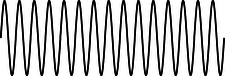
Figure c: Part of an infinite sine wave.
Of course the individual wave peaks do travel through space, and one might think that it would make sense to associate their speed with the “speed of stuff,” but as we will see, the two velocities are in general unequal when a wave's velocity depends on wavelength. Such a wave is called a dispersive wave, because a wave pulse consisting of a superposition of waves of different wavelengths will separate (disperse) into its separate wavelengths as the waves move through space at different speeds. Nearly all the waves we have encountered have been nondispersive. For instance, sound waves and light waves (in a vacuum) have speeds independent of wavelength. A water wave is one good example of a dispersive wave. Long-wavelength water waves travel faster, so a ship at sea that encounters a storm typically sees the long-wavelength parts of the wave first. When dealing with dispersive waves, we need symbols and words to distinguish the two speeds. The speed at which wave peaks move is called the phase velocity, \(v_p\), and the speed at which “stuff” moves is called the group velocity, \(v_g\).

Figure d: A finite-length sine wave.
An infinite sine wave can only tell us about the phase velocity, not the group velocity, which is really what we would be talking about when we referred to the speed of an electron. If an infinite sine wave is the simplest possible wave, what's the next best thing? We might think the runner up in simplicity would be a wave train consisting of a chopped-off segment of a sine wave, d. However, this kind of wave has kinks in it at the end. A simple wave should be one that we can build by superposing a small number of infinite sine waves, but a kink can never be produced by superposing any number of infinitely long sine waves.
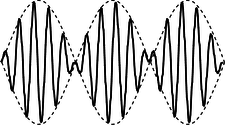
Figure e: A beat pattern created by superimposing two sine waves with slightly different wavelengths.
Actually the simplest wave that transports stuff from place to place is the pattern shown in figure e. Called a beat pattern, it is formed by superposing two sine waves whose wavelengths are similar but not quite the same. If you have ever heard the pulsating howling sound of musicians in the process of tuning their instruments to each other, you have heard a beat pattern. The beat pattern gets stronger and weaker as the two sine waves go in and out of phase with each other. The beat pattern has more “stuff” (energy, for example) in the areas where constructive interference occurs, and less in the regions of cancellation. As the whole pattern moves through space, stuff is transported from some regions and into other ones.
If the frequency of the two sine waves differs by 10%, for instance, then ten periods will be occur between times when they are in phase. Another way of saying it is that the sinusoidal “envelope” (the dashed lines in figure e) has a frequency equal to the difference in frequency between the two waves. For instance, if the waves had frequencies of 100 Hz and 110 Hz, the frequency of the envelope would be 10 Hz.
To apply similar reasoning to the wavelength, we must define a quantity z=1/λ that relates to wavelength in the same way that frequency relates to period. In terms of this new variable, the z of the envelope equals the difference between the z's of the two sine waves.
The group velocity is the speed at which the envelope moves through space. Let Δ f and Δ z be the differences between the frequencies and z's of the two sine waves, which means that they equal the frequency and z of the envelope. The group velocity is \(v_g =f_{envelope} λ_{envelope} =Δ f/Δz\). If Δ f and Δ z are sufficiently small, we can approximate this expression as a derivative,
$$v_g = \frac{df}{dz}$$
This expression is usually taken as the definition of the group velocity for wave patterns that consist of a superposition of sine waves having a narrow range of frequencies and wavelengths. In quantum mechanics, with f=E/h and z=p/h, we have \(v_g =dE/dp\). In the case of a nonrelativistic electron the relationship between energy and momentum is \(E=p^2 /2m\), so the group velocity is \(dE/dp=p/m=v\), exactly what it should be. It is only the phase velocity that differs by a factor of two from what we would have expected, but the phase velocity is not the physically important thing.
Bound States
Electrons are at their most interesting when they're in atoms, that is, when they are bound within a small region of space. We can understand a great deal about atoms and molecules based on simple arguments about such bound states, without going into any of the realistic details of atom. The simplest model of a bound state is known as the particle in a box: like a ball on a pool table, the electron feels zero force while in the interior, but when it reaches an edge it encounters a wall that pushes back inward on it with a large force. In particle language, we would describe the electron as bouncing off of the wall, but this incorrectly assumes that the electron has a certain path through space. It is more correct to describe the electron as a wave that undergoes 100% reflection at the boundaries of the box.
Like a generation of physics students before me, I rolled my eyes when initially introduced to the unrealistic idea of putting a particle in a box. It seemed completely impractical, an artificial textbook invention. Today, however, it has become routine to study electrons in rectangular boxes in actual laboratory experiments. The “box” is actually just an empty cavity within a solid piece of silicon, amounting in volume to a few hundred atoms. The methods for creating these electron-in-a-box setups (known as “quantum dots”) were a by-product of the development of technologies for fabricating computer chips.
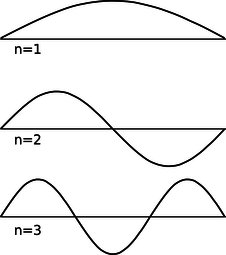
Figure f: Three possible standing-wave patterns for a particle in a box.
For simplicity let's imagine a one-dimensional electron in a box, i.e., we assume that the electron is only free to move along a line. The resulting standing wave patterns, of which the first three are shown in figure f, are just like some of the patterns we encountered with sound waves in musical instruments. The wave patterns must be zero at the ends of the box, because we are assuming the walls are impenetrable, and there should therefore be zero probability of finding the electron outside the box. Each wave pattern is labeled according to n, the number of peaks and valleys it has. In quantum physics, these wave patterns are referred to as “states” of the particle-in-the-box system.
The following seemingly innocuous observations about the particle in the box lead us directly to the solutions to some of the most vexing failures of classical physics:
The particle's energy is quantized (can only have certain values). Each wavelength corresponds to a certain momentum, and a given momentum implies a definite kinetic energy, \(E=p^2 /2m\). (This is the second type of energy quantization we have encountered. The type we studied previously had to do with restricting the number of particles to a whole number, while assuming some specific wavelength and energy for each particle. This type of quantization refers to the energies that a single particle can have. Both photons and matter particles demonstrate both types of quantization under the appropriate circumstances.)
The particle has a minimum kinetic energy. Long wavelengths correspond to low momenta and low energies. There can be no state with an energy lower than that of the n=1 state, called the ground state.
The smaller the space in which the particle is confined, the higher its kinetic energy must be. Again, this is because long wavelengths give lower energies.
Example 3: Spectra of thin gases

Figure g: The spectrum of the light from the star Sirius.
A fact that was inexplicable by classical physics was that thin gases absorb and emit light only at certain wavelengths. This was observed both in earthbound laboratories and in the spectra of stars. Figure g shows the example of the spectrum of the star Sirius, in which there are “gap teeth” at certain wavelengths. Taking this spectrum as an example, we can give a straightforward explanation using quantum physics.
Energy is released in the dense interior of the star, but the outer layers of the star are thin, so the atoms are far apart and electrons are confined within individual atoms. Although their standing-wave patterns are not as simple as those of the particle in the box, their energies are quantized.
When a photon is on its way out through the outer layers, it can be absorbed by an electron in an atom, but only if the amount of energy it carries happens to be the right amount to kick the electron from one of the allowed energy levels to one of the higher levels. The photon energies that are missing from the spectrum are the ones that equal the difference in energy between two electron energy levels. (The most prominent of the absorption lines in Sirius's spectrum are absorption lines of the hydrogen atom.)
Example 5: Chemical bonds in hydrogen molecules
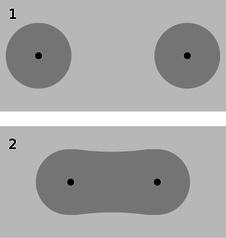
Figure h: Two hydrogen atoms bond to form an \(H_2\) molecule. In the molecule, the two electrons' wave patterns overlap, and are about twice as wide.
I began this chapter with a classical argument that chemical bonds, as in an \(H_2\) molecule, should not exist. Quantum physics explains why this type of bonding does in fact occur. When the atoms are next to each other, the electrons are shared between them. The “box” is about twice as wide, and a larger box allows a smaller energy. Energy is required in order to separate the atoms.
The uncertainty principle
Eliminating randomness through measurement?
A common reaction to quantum physics, among both early-twentieth-century physicists and modern students, is that we should be able to get rid of randomness through accurate measurement. If I say, for example, that it is meaningless to discuss the path of a photon or an electron, you might suggest that we simply measure the particle's position and velocity many times in a row. This series of snapshots would amount to a description of its path.
A practical objection to this plan is that the process of measurement will have an effect on the thing we are trying to measure. This may not be of much concern, for example, when a traffic cop measures your car's motion with a radar gun, because the energy and momentum of the radar pulses aren't enough to change the car's motion significantly. But on the subatomic scale it is a very real problem. Making a videotape of an electron orbiting a nucleus is not just difficult, it is theoretically impossible, even with the video camera hooked up to the best imaginable microscope. The video camera makes pictures of things using light that has bounced off them and come into the camera. If even a single photon of the right wavelength was to bounce off of the electron we were trying to study, the electron's recoil would be enough to change its behavior significantly.
The Heisenberg uncertainty principle
This insight, that measurement changes the thing being measured, is the kind of idea that clove-cigarette-smoking intellectuals outside of the physical sciences like to claim they knew all along. If only, they say, the physicists had made more of a habit of reading literary journals, they could have saved a lot of work. The anthropologist Margaret Mead has recently been accused of inadvertently encouraging her teenaged Samoan informants to exaggerate the freedom of youthful sexual experimentation in their society. If this is considered a damning critique of her work, it is because she could have done better: other anthropologists claim to have been able to eliminate the observer-as-participant problem and collect untainted data.
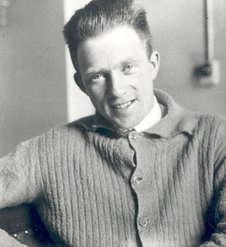
Figure i: Werner Heisenberg.
The German physicist Werner Heisenberg, however, showed that in quantum physics, any measuring technique runs into a brick wall when we try to improve its accuracy beyond a certain point. Heisenberg showed that the limitation is a question of what there is to be known, even in principle, about the system itself, not of the inability of a particular measuring device to ferret out information that is knowable.
Suppose, for example, that we have constructed an electron in a box (quantum dot) setup in our laboratory, and we are able to adjust the length L of the box as desired. All the standing wave patterns pretty much fill the box, so our knowledge of the electron's position is of limited accuracy. If we write Δ x for the range of uncertainty in our knowledge of its position, then Δ x is roughly the same as the length of the box:
$$Δ x ≈ L$$
If we wish to know its position more accurately, we can certainly squeeze it into a smaller space by reducing L, but this has an unintended side-effect. A standing wave is really a superposition of two traveling waves going in opposite directions. The equation p=h/λ only gives the magnitude of the momentum vector, not its direction, so we should really interpret the wave as a 50/50 mixture of a right-going wave with momentum p=h/λ and a left-going one with momentum p=-h/λ. The uncertainty in our knowledge of the electron's momentum is Δ p=2h/λ, covering the range between these two values. Even if we make sure the electron is in the ground state, whose wavelength λ =2L is the longest possible, we have an uncertainty in momentum of Δ p=h/L. In general, we find
$$Δ p \gtrsim h/L$$
with equality for the ground state and inequality for the higher-energy states. Thus if we reduce L to improve our knowledge of the electron's position, we do so at the cost of knowing less about its momentum. This trade-off is neatly summarized by multiplying the two equations to give
$$Δ pΔ x \gtrsim h $$
Although we have derived this in the special case of a particle in a box, it is an example of a principle of more general validity:
the Heisenberg uncertainty principle
It is not possible, even in principle, to know the momentum and the position of a particle simultaneously and with perfect accuracy. The uncertainties in these two quantities are always such that
$$Δ pΔ x \gtrsim h $$
(This approximation can be made into a strict inequality, Δ pΔ x>h/4π, but only with more careful definitions, which we will not bother with.)
Note that although I encouraged you to think of this derivation in terms of a specific real-world system, the quantum dot, I never made any reference to specific measuring equipment. The argument is simply that we cannot know the particle's position very accurately unless it has a very well defined position, it cannot have a very well defined position unless its wave-pattern covers only a very small amount of space, and its wave-pattern cannot be thus compressed without giving it a short wavelength and a correspondingly uncertain momentum. The uncertainty principle is therefore a restriction on how much there is to know about a particle, not just on what we can know about it with a certain technique.
Example 6: An estimate for electrons in atoms
◊ A typical energy for an electron in an atom is on the order of (1 volt)\(\cdot\) e, which corresponds to a speed of about 1% of the speed of light. If a typical atom has a size on the order of 0.1 nm, how close are the electrons to the limit imposed by the uncertainty principle?
◊ If we assume the electron moves in all directions with equal probability, the uncertainty in its momentum is roughly twice its typical momentum. This only an order-of-magnitude estimate, so we take Δ p to be the same as a typical momentum:
$$ΔpΔx = p_{typical} Δx$$ $$=(m_{electrons}) (0.01c) (0.1 \times 10^{-9} m)$$ $$=3\times 10^{-34} J \times s$$
This is on the same order of magnitude as Planck's constant, so evidently the electron is “right up against the wall.” (The fact that it is somewhat less than h is of no concern since this was only an estimate, and we have not stated the uncertainty principle in its most exact form.)
Historical Note
The true nature of Heisenberg's role in the Nazi atomic bomb effort is a fascinating question, and dramatic enough to have inspired a well-received 1998 theatrical play, “Copenhagen.” The real story, however, may never be completely unraveled. Heisenberg was the scientific leader of the German bomb program up until its cancellation in 1942, when the German military decided that it was too ambitious a project to undertake in wartime, and too unlikely to produce results.
Some historians believe that Heisenberg intentionally delayed and obstructed the project because he secretly did not want the Nazis to get the bomb. Heisenberg's apologists point out that he never joined the Nazi party, and was not anti-Semitic. He actively resisted the government's Deutsche-Physik policy of eliminating supposed Jewish influences from physics, and as a result was denounced by the S.S. as a traitor, escaping punishment only because Himmler personally declared him innocent. One strong piece of evidence is a secret message carried to the U.S. in 1941, by one of the last Jews to escape from Berlin, and eventually delivered to the chairman of the Uranium Committee, which was then studying the feasibility of a bomb. The message stated “...that a large number of German physicists are working intensively on the problem of the uranium bomb under the direction of Heisenberg, [and] that Heisenberg himself tries to delay the work as much as possible, fearing the catastrophic results of success. But he cannot help fulfilling the orders given to him, and if the problem can be solved, it will be solved probably in the near future. So he gave the advice to us to hurry up if U.S.A. will not come too late.” The message supports the view that Heisenberg intentionally misled his government about the bomb's technical feasibility; German Minister of Armaments Albert Speer wrote that he was convinced to drop the project after a 1942 meeting with Heisenberg because “the physicists themselves didn't want to put too much into it.” Heisenberg also may have warned Danish physicist Niels Bohr personally in September 1941 about the existence of the Nazi bomb effort.
On the other side of the debate, critics of Heisenberg say that he clearly wanted Germany to win the war, that he visited German-occupied territories in a semi-official role, and that he simply may not have been very good at his job directing the bomb project. On a visit to the occupied Netherlands in 1943, he told a colleague, “Democracy cannot develop sufficient energy to rule Europe. There are, therefore, only two alternatives: Germany and Russia. And then a Europe under German leadership would be the lesser evil.” Some historians argue that the real point of Heisenberg's meeting with Bohr was to try to convince the U.S. not to try to build a bomb, so that Germany, possessing a nuclear monopoly, would defeat the Soviets --- this was after the June 1941 entry of the U.S.S.R. into the war, but before the December 1941 Pearl Harbor attack brought the U.S. in. Bohr apparently considered Heisenberg's account of the meeting, published after the war was over, to be inaccurate. The secret 1941 message also has a curious moral passivity to it, as if Heisenberg was saying “I hope you stop me before I do something bad,” but we should also consider the great risk Heisenberg would have been running if he actually originated the message.
Measurement and Schrödinger's cat
If you hang around a laboratory where quantum-physics experiments are being done and secretly record the physicists' conversations, you'll hear them say many things that assume the probability interpretation of quantum mechanics. Usually they will speak as though the randomness of quantum mechanics enters the picture when something is measured. In the digital camera experiments of chapter 34, for example, they would casually describe the detection of a photon at one of the pixels as if the moment of detection was when the photon was forced to “make up its mind.” Although this mental cartoon usually works fairly well as a description of things one experiences in the lab, it cannot ultimately be correct, because it attributes a special role to measurement, which is really just a physical process like all other physical processes.
If we are to find an interpretation that avoids giving any special role to measurement processes, then we must think of the entire laboratory, including the measuring devices and the physicists themselves, as one big quantum-mechanical system made out of protons, neutrons, electrons, and photons. In other words, we should take quantum physics seriously as a description not just of microscopic objects like atoms but of human-scale (“macroscopic”) things like the apparatus, the furniture, and the people.
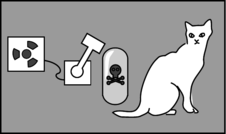
Figure j: Schrödinger's cat.
The most celebrated example is called the Schrödinger's cat experiment. Luckily for the cat, there probably was no actual experiment --- it was simply a “thought experiment” that the German theorist Schrödinger discussed with his colleagues. Schrödinger wrote:
One can even construct quite burlesque cases. A cat is shut up in a steel container, together with the following diabolical apparatus (which one must keep out of the direct clutches of the cat): In a [radiation detector] there is a tiny mass of radioactive substance, so little that in the course of an hour perhaps one atom of it disintegrates, but also with equal probability not even one; if it does happen, the [detector] responds and ... activates a hammer that shatters a little flask of prussic acid [filling the chamber with poison gas]. If one has left this entire system to itself for an hour, then one will say to himself that the cat is still living, if in that time no atom has disintegrated. The first atomic disintegration would have poisoned it.
Now comes the strange part. Quantum mechanics says that the particles the cat is made of have wave properties, including the property of superposition. Schrödinger describes the wavefunction of the box's contents at the end of the hour:
The wavefunction of the entire system would express this situation by having the living and the dead cat mixed ... in equal parts [50/50 proportions]. The uncertainty originally restricted to the atomic domain has been transformed into a macroscopic uncertainty...
At first Schrödinger's description seems like nonsense. When you opened the box, would you see two ghostlike cats, as in a doubly exposed photograph, one dead and one alive? Obviously not. You would have a single, fully material cat, which would either be dead or very, very upset. But Schrödinger has an equally strange and logical answer for that objection. In the same way that the quantum randomness of the radioactive atom spread to the cat and made its wavefunction a random mixture of life and death, the randomness spreads wider once you open the box, and your own wavefunction becomes a mixture of a person who has just killed a cat and a person who hasn't.
Electrons in electric fields
So far the only electron wave patterns we've considered have been simple sine waves, but whenever an electron finds itself in an electric field, it must have a more complicated wave pattern. Let's consider the example of an electron being accelerated by the electron gun at the back of a TV tube. The electron is moving from a region of low voltage into a region of higher voltage. Since its charge is negative, it loses PE by moving to a higher voltage, so its KE increases. As its potential energy goes down, its kinetic energy goes up by an equal amount, keeping the total energy constant. Increasing kinetic energy implies a growing momentum, and therefore a shortening wavelength, figure k.
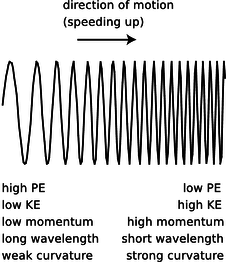
Figure k: An electron in a gentle electric field gradually shortens its wavelength as it gains energy.
The wavefunction as a whole does not have a single well-defined wavelength, but the wave changes so gradually that if you only look at a small part of it you can still pick out a wavelength and relate it to the momentum and energy. (The picture actually exaggerates by many orders of magnitude the rate at which the wavelength changes.)
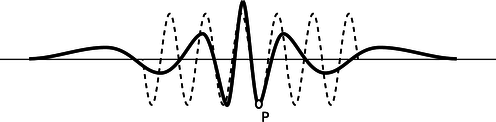
Figure l: A typical wavefunction of an electron in an atom (heavy curve) and the osculating sine wave (dashed curve) that matches its curvature at point P.
But what if the electric field was stronger? The electric field in a TV is only ∼\(10^5\) N/C, but the electric field within an atom is more like \(10^{12}\) N/C. In figure l, the wavelength changes so rapidly that there is nothing that looks like a sine wave at all. We could get a general idea of the wavelength in a given region by measuring the distance between two peaks, but that would only be a rough approximation. Suppose we want to know the wavelength at point P. The trick is to construct a sine wave, like the one shown with the dashed line, which matches the curvature of the actual wavefunction as closely as possible near P. The sine wave that matches as well as possible is called the “osculating” curve, from a Latin word meaning “to kiss.” The wavelength of the osculating curve is the wavelength that will relate correctly to conservation of energy.
Tunneling
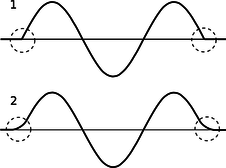
Figure m: 1. Kinks like this don't happen. 2. The wave actually penetrates into the classically forbidden region.
We implicitly assumed that the particle-in-a-box wavefunction would cut off abruptly at the sides of the box, m/1, but that would be unphysical. A kink has infinite curvature, and curvature is related to energy, so it can't be infinite. A physically realistic wavefunction must always “tail off” gradually, m/2. In classical physics, a particle can never enter a region in which its potential energy would be greater than the amount of energy it has available. But in quantum physics the wavefunction will always have a tail that reaches into the classically forbidden region. If it was not for this effect, called tunneling, the fusion reactions that power the sun would not occur due to the high potential energy that nuclei need in order to get close together! Tunneling is discussed in more detail in the next section.
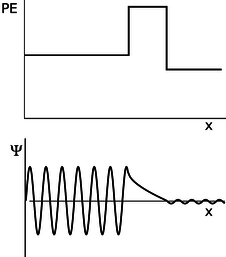
Figure n: Tunneling through a barrier.