Force and Motion
Article objectives
Force
We need only explain changes in motion, not motion itself.
You've studied the measurement of motion in some detail, but not the reasons why a certain object would move in a certain way. This article deals with the “why” questions. Aristotle's ideas about the causes of motion were completely wrong, just like all his other ideas about physical science, but it will be instructive to start with them, because they amount to a road map of modern students' incorrect preconceptions.
Aristotle thought he needed to explain both why motion occurs and why motion might change. Newton inherited from Galileo the important counter-Aristotelian idea that motion needs no explanation, that it is only changes in motion that require a physical cause. Aristotle's needlessly complex system gave three reasons for motion:
Natural motion, such as falling, came from the tendency of objects to go to their “natural” place, on the ground, and come to rest.
Voluntary motion was the type of motion exhibited by animals, which moved because they chose to.
Forced motion occurred when an object was acted on by some other object that made it move.

Figure a: Aristotle said motion had to be caused by a force. To explain why an arrow kept flying after the bowstring was no longer pushing on it, he said the air rushed around behind the arrow and pushed it forward. This is wrong, because an arrow shot in a vacuum chamber does not instantly drop to the floor as it leaves the bow. Galileo and Newton realized that a force would only be needed to change the arrow's motion, not to make its motion continue.

Figure b: “Our eyes receive blue light reflected from this painting because Monet wanted to represent water with the color blue.” This is a valid statement at one level of explanation, but physics works at the physical level of explanation, in which blue light gets to your eyes because it is reflected by blue pigments in the paint.
Motion changes due to an interaction between two objects.
In the Aristotelian theory, natural motion and voluntary motion are one-sided phenomena: the object causes its own motion. Forced motion is supposed to be a two-sided phenomenon, because one object imposes its “commands” on another. Where Aristotle conceived of some of the phenomena of motion as one-sided and others as two-sided, Newton realized that a change in motion was always a two-sided relationship of a force acting between two physical objects.
The one-sided “natural motion” description of falling makes a crucial omission. The acceleration of a falling object is not caused by its own “natural” tendencies but by an attractive force between it and the planet Earth. Moon rocks brought back to our planet do not “want” to fly back up to the moon because the moon is their “natural” place. They fall to the floor when you drop them, just like our homegrown rocks. Gravitational forces are simply an attraction that occurs between any two physical objects. Minute gravitational forces can even be measured between human-scale objects in the laboratory.
The idea of natural motion also explains incorrectly why things come to rest. A basketball rolling across a beach slows to a stop because it is interacting with the sand via a frictional force, not because of its own desire to be at rest. If it was on a frictionless surface, it would never slow down. Many of Aristotle's mistakes stemmed from his failure to recognize friction as a force.
The concept of voluntary motion is equally flawed. You may have been a little uneasy about it from the start, because it assumes a clear distinction between living and nonliving things. Today, however, we are used to having the human body likened to a complex machine. In the modern world-view, the border between the living and the inanimate is a fuzzy no-man's land inhabited by viruses, prions, and silicon chips. Furthermore, Aristotle's statement that you can take a step forward “because you choose to” inappropriately mixes two levels of explanation. At the physical level of explanation, the reason your body steps forward is because of a frictional force acting between your foot and the floor. If the floor was covered with a puddle of oil, no amount of “choosing to” would enable you to take a graceful stride forward.
Forces can all be measured on the same numerical scale.
In the Aristotelian-scholastic tradition, the description of motion as natural, voluntary, or forced was only the broadest level of classification, like splitting animals into birds, reptiles, mammals, and amphibians. There might be thousands of types of motion, each of which would follow its own rules. Newton's realization that all changes in motion were caused by two-sided interactions made it seem that the phenomena might have more in common than had been apparent. In the Newtonian description, there is only one cause for a change in motion, which we call force. Forces may be of different types, but they all produce changes in motion according to the same rules. Any acceleration that can be produced by a magnetic force can equally well be produced by an appropriately controlled stream of water. We can speak of two forces as being equal if they produce the same change in motion when applied in the same situation, which means that they pushed or pulled equally hard in the same direction.
To recapitulate briefly, a force is when a pair of objects push or pull on each other, and one newton is the force required to accelerate a 1-kg object from rest to a speed of 1 m/s in 1 second.
More than one force on an object
As if we hadn't kicked poor Aristotle around sufficiently, his theory has another important flaw, which is important to discuss because it corresponds to an extremely common student misconception. Aristotle conceived of forced motion as a relationship in which one object was the boss and the other “followed orders.” It therefore would only make sense for an object to experience one force at a time, because an object couldn't follow orders from two sources at once. In the Newtonian theory, forces are numbers, not orders, and if more than one force acts on an object at once, the result is found by adding up all the forces. It is unfortunate that the use of the English word “force” has become standard, because to many people it suggests that you are “forcing” an object to do something. The force of the earth's gravity cannot “force” a boat to sink, because there are other forces acting on the boat. Adding them up gives a total of zero, so the boat accelerates neither up nor down.
Objects can exert forces on each other at a distance.
Aristotle declared that forces could only act between objects that were touching, probably because he wished to avoid the type of occult speculation that attributed physical phenomena to the influence of a distant and invisible pantheon of gods. He was wrong, however, as you can observe when a magnet leaps onto your refrigerator or when the planet earth exerts gravitational forces on objects that are in the air. Some types of forces, such as friction, only operate between objects in contact, and are called contact forces. Magnetism, on the other hand, is an example of a noncontact force. Although the magnetic force gets stronger when the magnet is closer to your refrigerator, touching is not required.
Weight
In physics, an object's weight, F\(_{W}\), is defined as the earth's gravitational force on it. The SI unit of weight is therefore the Newton. People commonly refer to the kilogram as a unit of weight, but the kilogram is a unit of mass, not weight. Note that an object's weight is not a fixed property of that object. Objects weigh more in some places than in others, depending on the local strength of gravity. It is their mass that always stays the same. A baseball pitcher who can throw a 90-mile-per-hour fastball on earth would not be able to throw any faster on the moon, because the ball's inertia would still be the same.

Figure c: Forces are applied to a saxophone. In this example, positive signs have been used consistently for forces to the right, and negative signs for forces to the left. (The forces are being applied to different places on the saxophone, but the numerical value of a force carries no information about that.)
Positive and negative signs of force
We'll start by considering only cases of one-dimensional center-of-mass motion in which all the forces are parallel to the direction of motion, i.e., either directly forward or backward. In one dimension, plus and minus signs can be used to indicate directions of forces, as shown in figure c. We can then refer generically to addition of forces, rather than having to speak sometimes of addition and sometimes of subtraction. We add the forces shown in the figure and get 11 N. In general, we should choose a one-dimensional coordinate system with its x axis parallel the direction of motion. Forces that point along the positive x axis are positive, and forces in the opposite direction are negative. Forces that are not directly along the x axis cannot be immediately incorporated into this scheme, but that's OK, because we're avoiding those cases for now.
Newton's First Law
We are now prepared to make a more powerful restatement of the principle of inertia.
Newton's first law
If the total force acting on an object is zero, its center of mass continues in the same state of motion.
In other words, an object initially at rest is predicted to remain at rest if the total force on it is zero, and an object in motion remains in motion with the same velocity in the same direction. The converse of Newton's first law is also true: if we observe an object moving with constant velocity along a straight line, then the total force on it must be zero.
You may encounter the term “net force,” which is simply a synonym for total force,
What happens if the total force on an object is not zero? It accelerates. Numerical prediction of the resulting acceleration is the topic of Newton's second law.
This is the first of Newton's three laws of motion. It is not important to memorize which of Newton's three laws are numbers one, two, and three. If a future physics teacher asks you something like, “Which of Newton's laws are you thinking of?,” a perfectly acceptable answer is “The one about constant velocity when there's zero total force.” The concepts are more important than any specific formulation of them. Clear writing was not in vogue in Newton's day, and he formulated his three laws in terms of a concept now called momentum, only later relating it to the concept of force. Nearly all modern texts, including this one, start with force and do momentum later.
Example 1: An elevator
◊ An elevator has a weight of 5000 N. Compare the forces that the cable must exert to raise it at constant velocity, lower it at constant velocity, and just keep it hanging.
◊ In all three cases the cable must pull up with a force of exactly 5000 N. Most people think you'd need at least a little more than 5000 N to make it go up, and a little less than 5000 N to let it down, but that's incorrect. Extra force from the cable is only necessary for speeding the car up when it starts going up or slowing it down when it finishes going down. Decreased force is needed to speed the car up when it gets going down and to slow it down when it finishes going up. But when the elevator is cruising at constant velocity, Newton's first law says that you just need to cancel the force of the earth's gravity.
To many students, the statement in the example that the cable's upward force “cancels” the earth's downward gravitational force implies that there has been a contest, and the cable's force has won, vanquishing the earth's gravitational force and making it disappear. That is incorrect. Both forces continue to exist, but because they add up numerically to zero, the elevator has no center-of-mass acceleration. We know that both forces continue to exist because they both have side-effects other than their effects on the car's center-of-mass motion. The force acting between the cable and the car continues to produce tension in the cable and keep the cable taut. The earth's gravitational force continues to keep the passengers (whom we are considering as part of the elevator-object) stuck to the floor and to produce internal stresses in the walls of the car, which must hold up the floor.
Example 2: Terminal velocity for falling objects
◊ An object like a feather that is not dense or streamlined does not fall with constant acceleration, because air resistance is nonnegligible. In fact, its acceleration tapers off to nearly zero within a fraction of a second, and the feather finishes dropping at constant speed (known as its terminal velocity). Why does this happen?
◊ Newton's first law tells us that the total force on the feather must have been reduced to nearly zero after a short time. There are two forces acting on the feather: a downward gravitational force from the planet earth, and an upward frictional force from the air. As the feather speeds up, the air friction becomes stronger and stronger, and eventually it cancels out the earth's gravitational force, so the feather just continues with constant velocity without speeding up any more.
The situation for a skydiver is exactly analogous. It's just that the skydiver experiences perhaps a million times more gravitational force than the feather, and it is not until she is falling very fast that the force of air friction becomes as strong as the gravitational force. It takes her several seconds to reach terminal velocity, which is on the order of a hundred miles per hour.
More general combinations of forces
It is too constraining to restrict our attention to cases where all the forces lie along the line of the center of mass's motion. For one thing, we can't analyze any case of horizontal motion, since any object on earth will be subject to a vertical gravitational force! For instance, when you are driving your car down a straight road, there are both horizontal forces and vertical forces. However, the vertical forces have no effect on the center of mass motion, because the road's upward force simply counteracts the earth's downward gravitational force and keeps the car from sinking into the ground.
The following slight generalization of Newton's first law allows us to analyze a great many cases of interest:
Suppose that an object has two sets of forces acting on it, one set along the line of the object's initial motion and another set perpendicular to the first set. If both sets of forces cancel, then the object's center of mass continues in the same state of motion.
Example 3: A passenger riding the subway
◊ Describe the forces acting on a person standing in a subway train that is cruising at constant velocity.
◊ No force is necessary to keep the person moving relative to the ground. He will not be swept to the back of the train if the floor is slippery. There are two vertical forces on him, the earth's downward gravitational force and the floor's upward force, which cancel. There are no horizontal forces on him at all, so of course the total horizontal force is zero.
Example 4: Forces on a sailboat
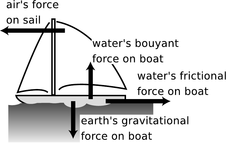
Figure d: Example 4.
◊ If a sailboat is cruising at constant velocity with the wind coming from directly behind it, what must be true about the forces acting on it? ◊ The forces acting on the boat must be canceling each other out. The boat is not sinking or leaping into the air, so evidently the vertical forces are canceling out. The vertical forces are the downward gravitational force exerted by the planet earth and an upward force from the water.
The air is making a forward force on the sail, and if the boat is not accelerating horizontally then the water's backward frictional force must be canceling it out.
Contrary to Aristotle, more force is not needed in order to maintain a higher speed. Zero total force is always needed to maintain constant velocity. Consider the following made-up numbers:
| Boat moving at a low, constant velocity | Boat moving at a high, constant velocity |
|---|
The faster boat still has zero total force on it. The forward force on it is greater, and the backward force smaller (more negative), but that's irrelevant because Newton's first law has to do with the total force, not the individual forces.
This example is quite analogous to the one about terminal velocity of falling objects, since there is a frictional force that increases with speed. After casting off from the dock and raising the sail, the boat will accelerate briefly, and then reach its terminal velocity, at which the water's frictional force has become as great as the wind's force on the sail.
Example 5: A car crash
◊ If you drive your car into a brick wall, what is the mysterious force that slams your face into the steering wheel?
◊ Your surgeon has taken physics, so she is not going to believe your claim that a mysterious force is to blame. She knows that your face was just following Newton's first law. Immediately after your car hit the wall, the only forces acting on your head were the same canceling-out forces that had existed previously: the earth's downward gravitational force and the upward force from your neck. There were no forward or backward forces on your head, but the car did experience a backward force from the wall, so the car slowed down and your face caught up.
Newton's Second Law
What about cases where the total force on an object is not zero, so that Newton's first law doesn't apply? The object will have an acceleration. The way we've defined positive and negative signs of force and acceleration guarantees that positive forces produce positive accelerations, and likewise for negative values. How much acceleration will it have? It will clearly depend on both the object's mass and on the amount of force.
Experiments with any particular object show that its acceleration is directly proportional to the total force applied to it. This may seem wrong, since we know of many cases where small amounts of force fail to move an object at all, and larger forces get it going. This apparent failure of proportionality actually results from forgetting that there is a frictional force in addition to the force we apply to move the object. The object's acceleration is exactly proportional to the total force on it, not to any individual force on it. In the absence of friction, even a very tiny force can slowly change the velocity of a very massive object.
Experiments also show that the acceleration is inversely proportional to the object's mass, and combining these two proportionalities gives the following way of predicting the acceleration of any object:
$$a=F_{total}/m$$
where m is an object's mass, F\(_{total}\) is the sum of the forces acting on it, and a is the acceleration of the object's center of mass.
We are presently restricted to the case where the forces of interest are parallel to the direction of motion.
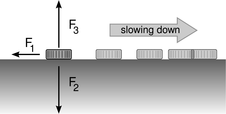
Figure e: A coin slides across a table. Even for motion in one dimension, some of the forces may not lie along the line of the motion.
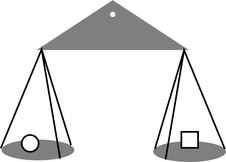
Figure f: A simple double-pan balance works by comparing the weight forces exerted by the earth on the contents of the two pans. Since the two pans are at almost the same location on the earth's surface, the value of g is essentially the same for each one, and equality of weight therefore also implies equality of mass.
Example 6: An accelerating bus
◊ A VW bus with a mass of 2000 kg accelerates from 0 to 25 m/s (freeway speed) in 34 s. Assuming the acceleration is constant, what is the total force on the bus?
◊ We solve Newton's second law for Ftotal=ma, and substitute Δ v/Δ t for a, giving
$$F_{total} =mΔv/Δt =(2000 kg)(25 m/s-0 m/s)/(34 s) =1.5 kN.$$
A generalization
As with the first law, the second law can be easily generalized to include a much larger class of interesting situations:
Suppose an object is being acted on by two sets of forces, one set lying parallel to the object's initial direction of motion and another set acting along a perpendicular line. If the forces perpendicular to the initial direction of motion cancel out, then the object accelerates along its original line of motion according to a=\(F_{||}\)/m, where \(F_{||}\) is the sum of the forces parallel to the line.
Example 7: A coin sliding across a table
Suppose a coin is sliding to the right across a table, figure e, and let's choose a positive x axis that points to the right. The coin's velocity is positive, and we expect based on experience that it will slow down, i.e., its acceleration should be negative.
Although the coin's motion is purely horizontal, it feels both vertical and horizontal forces. The Earth exerts a downward gravitational force \(F_{2}\) on it, and the table makes an upward force \(F_{3}\) that prevents the coin from sinking into the wood. In fact, without these vertical forces the horizontal frictional force wouldn't exist: surfaces don't exert friction against one another unless they are being pressed together.
Although \(F_{2}\) and \(F_{3}\) contribute to the physics, they do so only indirectly. The only thing that directly relates to the acceleration along the horizontal direction is the horizontal force: a=\(F_{1}\)/m.
The relationship between mass and weight
Mass is different from weight, but they're related. An apple's mass tells us how hard it is to change its motion. Its weight measures the strength of the gravitational attraction between the apple and the planet earth. The apple's weight is less on the moon, but its mass is the same. Astronauts assembling the International Space Station in zero gravity cannot just pitch massive modules back and forth with their bare hands; the modules are weightless, but not massless.
We have already seen the experimental evidence that when weight (the force of the earth's gravity) is the only force acting on an object, its acceleration equals the constant g, and g depends on where you are on the surface of the earth, but not on the mass of the object. Applying Newton's second law then allows us to calculate the magnitude of the gravitational force on any object in terms of its mass:
$$|F_{W}|=mg $$
(The equation only gives the magnitude, i.e. the absolute value, of F\(_{W}\), because we're defining g as a positive number, so it equals the absolute value of a falling object's acceleration.)
Example 8: Weight and mass
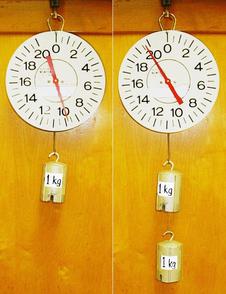
Figure g
◊ Figure g shows masses of one and two kilograms hung from a spring scale, which measures force in units of newtons. Explain the readings.
◊ Let's start with the single kilogram. It's not accelerating, so evidently the total force on it is zero: the spring scale's upward force on it is canceling out the earth's downward gravitational force. The spring scale tells us how much force it is being obliged to supply, but since the two forces are equal in strength, the spring scale's reading can also be interpreted as measuring the strength of the gravitational force, i.e., the weight of the one-kilogram mass. The weight of a one-kilogram mass should be
$$F_{W} =mg =(1.0 kg)(9.8 m/s2)=9.8 N,$$
and that's indeed the reading on the spring scale.
Similarly for the two-kilogram mass, we have
$$F_{W} =mg =(2.0 kg)(9.8 m/s2)=19.6 N.$$
Example 9: Calculating terminal velocity
◊ Experiments show that the force of air friction on a falling object such as a skydiver or a feather can be approximated fairly well with the equation |F\(_{air}\)|=cρ Av\(^{2}\), where c is a constant, ρ is the density of the air, A is the cross-sectional area of the object as seen from below, and v is the object's velocity. Predict the object's terminal velocity, i.e., the final velocity it reaches after a long time.
◊ As the object accelerates, its greater v causes the upward force of the air to increase until finally the gravitational force and the force of air friction cancel out, after which the object continues at constant velocity. We choose a coordinate system in which positive is up, so that the gravitational force is negative and the force of air friction is positive. We want to find the velocity at which
$$F_{air}+F_W =0,\; \;\; i.e., cρAv^2-mg =0$$
Solving for v gives
$$v_{terminal}=mgcρA$$
What force is not
Violin teachers have to endure their beginning students' screeching. A frown appears on the woodwind teacher's face as she watches her student take a breath with an expansion of his ribcage but none in his belly. What makes physics teachers cringe is their students' verbal statements about forces. Below are six dicta about what force is not.
1. Force is not a property of one object.
A great many of students' incorrect descriptions of forces could be cured by keeping in mind that a force is an interaction of two objects, not a property of one object.
Incorrect statement: “That magnet has a lot of force.”
If the magnet is one millimeter away from a steel ball bearing, they may exert a very strong attraction on each other, but if they were a meter apart, the force would be virtually undetectable. The magnet's strength can be rated using certain electrical units (ampere-meters\(^{2}\)), but not in units of force.
2. Force is not a measure of an object's motion.
If force is not a property of a single object, then it cannot be used as a measure of the object's motion.
Incorrect statement: “The freight train rumbled down the tracks with awesome force.”
Force is not a measure of motion. If the freight train collides with a stalled cement truck, then some awesome forces will occur, but if it hits a fly the force will be small.
3. Force is not energy.
There are two main approaches to understanding the motion of objects, one based on force and one on a different concept, called energy. The SI unit of energy is the Joule, but you are probably more familiar with the calorie, used for measuring food's energy, and the kilowatt-hour, the unit the electric company uses for billing you. Physics students' previous familiarity with calories and kilowatt-hours is matched by their universal unfamiliarity with measuring forces in units of Newtons, but the precise operational definitions of the energy concepts are more complex than those of the force concepts, and textbooks, including this one, almost universally place the force description of physics before the energy description. During the long period after the introduction of force and before the careful definition of energy, students are therefore vulnerable to situations in which, without realizing it, they are imputing the properties of energy to phenomena of force.
Incorrect statement: “How can my chair be making an upward force on my rear end? It has no power!”
Power is a concept related to energy, e.g., a 100-watt lightbulb uses up 100 joules per second of energy. When you sit in a chair, no energy is used up, so forces can exist between you and the chair without any need for a source of power.
4. Force is not stored or used up.
Because energy can be stored and used up, people think force also can be stored or used up.
Incorrect statement: “If you don't fill up your tank with gas, you'll run out of force.”
Energy is what you'll run out of, not force.
5. Forces need not be exerted by living things or machines.
Transforming energy from one form into another usually requires some kind of living or mechanical mechanism. The concept is not applicable to forces, which are an interaction between objects, not a thing to be transferred or transformed.
Incorrect statement: “How can a wooden bench be making an upward force on my rear end? It doesn't have any springs or anything inside it.”
No springs or other internal mechanisms are required. If the bench didn't make any force on you, you would obey Newton's second law and fall through it. Evidently it does make a force on you!
6. A force is the direct cause of a change in motion.
When we speak of a force on an object in physics, we are talking about a force that acts directly. Similarly, when you pull a reluctant dog along by its leash, the leash and the dog are making forces on each other, not your hand and the dog. The dog is not even touching your hand.
Inertial and noninertial frames of reference
One day, you're driving down the street in your pickup truck, on your way to deliver a bowling ball. The ball is in the back of the truck, enjoying its little jaunt and taking in the fresh air and sunshine. Then you have to slow down because a stop sign is coming up. As you brake, you glance in your rearview mirror, and see your trusty companion accelerating toward you. Did some mysterious force push it forward? No, it only seems that way because you and the car are slowing down. The ball is faithfully obeying Newton's first law, and as it continues at constant velocity it gets ahead relative to the slowing truck. No forces are acting on it (other than the same canceling-out vertical forces that were always acting on it). The ball only appeared to violate Newton's first law because there was something wrong with your frame of reference, which was based on the truck.
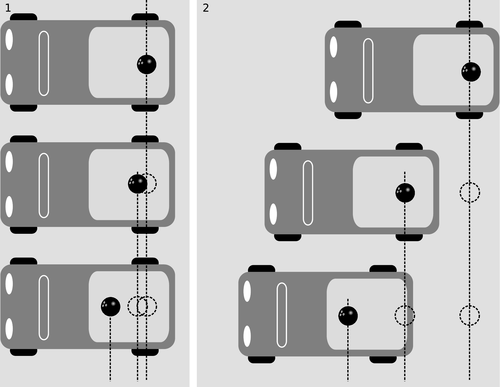
Figure h: 1. In a frame of reference that moves with the truck, the bowling ball appears to violate Newton's first law by accelerating despite having no horizontal forces on it. 2. In an inertial frame of reference, which the surface of the earth approximately is, the bowling ball obeys Newton's first law. It moves equal distances in equal time intervals, i.e., maintains constant velocity. In this frame of reference, it is the truck that appears to have a change in velocity, which makes sense, since the road is making a horizontal force on it.
How, then, are we to tell in which frames of reference Newton's laws are valid? It's no good to say that we should avoid moving frames of reference, because there is no such thing as absolute rest or absolute motion. All frames can be considered as being either at rest or in motion. According to an observer in India, the strip mall that constituted the frame of reference in panel (b) of the figure was moving along with the earth's rotation at hundreds of miles per hour.
The reason why Newton's laws fail in the truck's frame of reference is not because the truck is moving but because it is accelerating. (Recall that physicists use the word to refer either to speeding up or slowing down.) Newton's laws were working just fine in the moving truck's frame of reference as long as the truck was moving at constant velocity. It was only when its speed changed that there was a problem. How, then, are we to tell which frames are accelerating and which are not? What if you claim that your truck is not accelerating, and the sidewalk, the asphalt, and the Burger King are accelerating? The way to settle such a dispute is to examine the motion of some object, such as the bowling ball, which we know has zero total force on it. Any frame of reference in which the ball appears to obey Newton's first law is then a valid frame of reference, and to an observer in that frame, Mr. Newton assures us that all the other objects in the universe will obey his laws of motion, not just the ball.
Valid frames of reference, in which Newton's laws are obeyed, are called inertial frames of reference. Frames of reference that are not inertial are called noninertial frames. In those frames, objects violate the principle of inertia and Newton's first law. While the truck was moving at constant velocity, both it and the sidewalk were valid inertial frames. The truck became an invalid frame of reference when it began changing its velocity.
You usually assume the ground under your feet is a perfectly inertial frame of reference, and we made that assumption above. It isn't perfectly inertial, however. Its motion through space is quite complicated, being composed of a part due to the earth's daily rotation around its own axis, the monthly wobble of the planet caused by the moon's gravity, and the rotation of the earth around the sun. Since the accelerations involved are numerically small, the earth is approximately a valid inertial frame.
Noninertial frames are avoided whenever possible. Sometimes, however, a noninertial frame can be convenient. Naval gunners, for instance, get all their data from radars, human eyeballs, and other detection systems that are moving along with the earth's surface. Since their guns have ranges of many miles, the small discrepancies between their shells' actual accelerations and the accelerations predicted by Newton's second law can have effects that accumulate and become significant. In order to kill the people they want to kill, they have to add small corrections onto the equation a=F\(_{total}\)/m. Doing their calculations in an inertial frame would allow them to use the usual form of Newton's second law, but they would have to convert all their data into a different frame of reference, which would require cumbersome calculations.