Mendel's Investigation
Article objectives
For thousands of years, humans have understood that characteristics such as eye color or flower color are passed from one generation to the next. The passing of characteristics from parent to offspring is called heredity. Humans have long been interested in understanding heredity. Many hereditary mechanisms were developed by scholars but were not properly tested or quantified. The scientific study of genetics did not begin until the late 19th century. In experiments with garden peas, Austrian monk Gregor Mendel described the patterns of inheritance.
Gregor Mendel: Teacher and Scientist
Gregor Johann Mendel was an Augustinian monk, a teacher, and a scientist (Figure 1). He is often called the ”father of modern genetics” for his study of the inheritance of traits in pea plants. Mendel showed that the inheritance of traits follows particular laws, which were later named after him. The significance of Mendel’s work was not recognized until the turn of the 20th century. The rediscovery of his work led the foundation for the era of modern genetics, the branch of biology that focuses on heredity in organisms.

Figure 1: Gregor Johann Mendel “The Father of Modern Genetics.” 1822-1884.
Johann Mendel was born in 1822 and grew up on his parents’ farm in an area of Austria that is now in the Czech Republic. He overcame financial hardship and ill health to excel in school. In 1843 he entered the Augustinian Abbey in Brünn (now Brno, Czech Republic.) Upon entering monastic life, he took the name Gregor. While at the monastery, Mendel also attended lectures on the growing of fruit and agriculture at the Brünn Philosophical Institute. In 1849 he accepted a teaching job, but a year later he failed the state teaching examination. One of his examiners recommended that he be sent to university for further studies. In 1851 he was sent to the University of Vienna to study natural science and mathematics. Mendel’s time at Vienna was very important in his development as a scientist. His professors encouraged him to learn science through experimentation and to use mathematics to help explain observations of natural events. He returned to Brünn in 1854 as a natural history and physics teacher.
Mendel's Experiment
In 1853 and 1854, Mendal published two papers on crop damage by insects. However, he is best known for his later studies of the pea plant Pisum sativum. Mendel was inspired by both his professors at university and his colleagues at the monastery to study variation in plants. He had carried out artificial fertilization on plants many times in order to grow a plant with a new color or seed shape. Artificial fertilization is the process of transferring pollen from the male part of the flower to the female part of another flower. Artificial fertilization is done in order to have seeds that will grow into plants that have a desired trait, such as yellow flowers.
During Mendel’s time, the popular blending inheritance hypothesis stated that offspring were a ”mix” of their parents. For example, if a pea plant had one short parent and one tall parent, that pea plant would be of medium height. It was believed that the offspring would then pass on heritable units, or factors, for medium sized offspring. (Today we know these heritable units are genes; however, Mendel did not know of the concept of a gene.) Mendel noted that plants in the monastery gardens sometimes gave rise to plants that were not exactly like the parent plants, nor were they a “mix” of the parents. He also noted that certain traits reappeared after “disappearing” in an earlier generation. Mendel was interested in finding out if there was a predictable pattern to the inheritance of traits. Between 1856 and 1863 he grew and tested about 29,000 pea plants in the monastery garden.
Mendel may have chosen to study peas because they are fast-growing plants that are available in different varieties. For example, one variety of pea plant has purple flowers, as shown in Figure 2, while another variety has white flowers.

Figure 2: Pisum sativum, the pea plant species that Mendel studied.
Mendel chose to study seven characteristics of pea plants. A characteristic is a heritable feature, such as flower color. Each characteristic Mendel chose to study occurred in two contrasting traits. A trait is a heritable variant of a characteristic, such as purple or white flower color. Table 1 lists the seven characteristics Mendel studied, and their two contrasting traits.
Table 1 The Seven Characteristics Mendel Studied and Their Contrasting Traits
| Flower Color | Flower Position on Stem | Stem Length | Pod Shape | Pod Color | Seed Shape | Seed Color |
|---|---|---|---|---|---|---|
| violet-red (purple) | axial | tall | inflated | green | round | green |
| white | terminal | short | constricted | yellow | wrinkled | yellow |
Pea Plant Pollination
In order to study these characteristics, Mendel needed to control the pollination of the pea plants. Pollination occurs when the pollen from the male reproductive part of a flower, called the anthers, is transferred to the female reproductive part of a flower, called the stigma. Pea plants are self-pollinating, which means the pollen from a flower on a single plant transfers to the stigma of the same flower or another flower on the same plant. In order to avoid self-pollination, Mendel removed the anthers from the flowers on a plant. He then carefully transferred pollen from the anthers of another plant and dusted the pollen onto the stamen of the flowers that lacked anthers. This process caused cross-pollination. Cross-pollination occurs when pollen from one flower pollinates a flower on a different plant. In this way, Mendel controlled the characteristics that were passed onto the offspring. Figure 3 shows the location of the male and female parts of P. sativum.
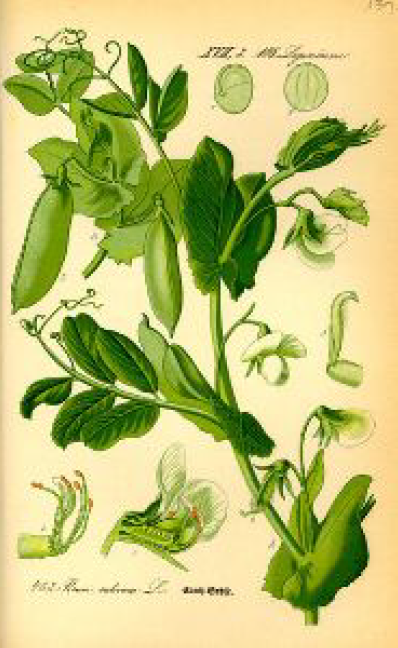
Figure 3: The location of the anthers in the pea flower. The anthers are illustrated alone in the image to the left of the transected flower (at right). Mendel controlled pollination of the plants by removing the immature anthers of certain plants.
Mendel's First Experiment
Mendel began his studies by growing plants that were true-breeding for a particular trait. A true-breeding plant will always produce offspring with that trait when they self-pollinate. For example, a true-breeding plant with yellow seeds will always have offspring that have yellow seeds. In his first experiment, Mendel cross-pollinated two true-breeding plants of contrasting traits, such as purple and white flowered plants. The true-breeding parent plants are referred to as the P generation (parental generation). The hybrid offspring of the P generation are called the \(F_1\) generation (filial generation). The hybrid offspring of the \(F_1\) generation are called the \(F_2\) generation (filial generation).
Monohybrid Crosses
Mendel first worked with plants that differed in a single characteristic, such as flower color. A hybridization is a cross between two individuals that have different traits. A hybridization in which only one characteristic is examined is called a monohybrid cross. The offspring of such a cross are called monohybrids. Mendel noted that hybridizing true-breeding (Pgeneration) plants gave rise to an F1 generation that showed only one trait of a characteristic. For example, a true-breeding purple-flowering plant crossed with a true-breeding whiteflowering plant always gave rise to purple-flowered hybrid plants. There were no whiteflowered hybrids! Mendel wanted to know what happened to the white-flowered plants’ “heritable factors.” If indeed the white-flower “heritable factor” had disappeared, all future offspring of the hybrids would be purple-flowered. To test this idea, Mendel let the \(F_1\) generation plants self-pollinate and then planted the resulting seeds.
Mendel's Results
The \(F_2\) generation plants that grew included white-flowered plants! Mendel noted the ratio of white flowered plants to purple-flowered plants was about 3:1. That is, for every three purple-flowered plants, there was one white flowered plant. Figure 4 shows Mendel’s results for the characteristic of flower color.

Figure 4: Illustration of Table 2.
Mendel carried out identical studies over three generations, (P, \(F_1\), and \(F_2\)), for the other six characteristics and found in each case that one trait “disappeared” in the \(F_1\) generation, only to reappear in the \(F_2\) generation. Mendel studied a large number of plants, as shown in Table 2, so he was confident that the ratios of different traits in the \(F_2\) generation were representative.
Table 2 Results of \(F_1\) Generation Crosses for Seven Characteristics
| Characteristic | Dominant Trait | Recessive Trait | \(F_2\) Generation Dominant:Recessive | Ratio |
|---|---|---|---|---|
| Flower color | Purple | White | 705:224 | 3.15:1 |
| Flower position on stem | Axial | Terminal | 651:207 | 3.14:1 |
| Stem length | Tall | Short | 787:277 | 2.84:1 |
| Pod Shape | Inflated | Constricted | 882:299 | 2.95:1 |
| Pod color | Green | Yellow | 428:152 | 2.82:1 |
| Seed shape | Round | Wrinkled or angular | 5474:1850 | 2.96:1 |
| Seed color | Yellow | Green | 6022:2001 | 3.01:1 |
Mendel's Theory of Heredity
Based on his observations, Mendel developed four hypotheses. These hypotheses are known as Mendel’s theory of heredity. The hypotheses explain a simple form of inheritance in which two alleles of a gene are inherited to result in one of several traits in offspring. In modern terms, these hypotheses are:
-
There are different versions of genes. These different versions account for variations in characteristics. Different versions of a gene are called alleles. For example, there is a “yellow-pod” allele and a “green pod” allele. The blending inheritance hypothesis was discredited by Mendel’s allele hypothesis.
-
When two different alleles are inherited together, one may be expressed, while the effect of the other may be “silenced.” In the case of pod color, the allele for green pods is always expressed and is dominant. The allele for yellow pods, which is not expressed, is recessive. For instance, if a plant inherits a “yellow-pod” gene and a “green pod” gene, it will have only green pods.
-
For each characteristic, an organism inherits two alleles, one from each parent. Mendel noted that offspring could inherit their traits from either parent. In the case of the expressed trait, it did not matter whether it was the male gamete or female gamete that supplied the gene.
-
When gametes are formed, the two alleles of each gene are separated (Figure 5). During meiosis, each male or female gamete receives one allele for a trait. When the male and female gametes are fused at fertilization, the resulting zygote contains two alleles of each gene.
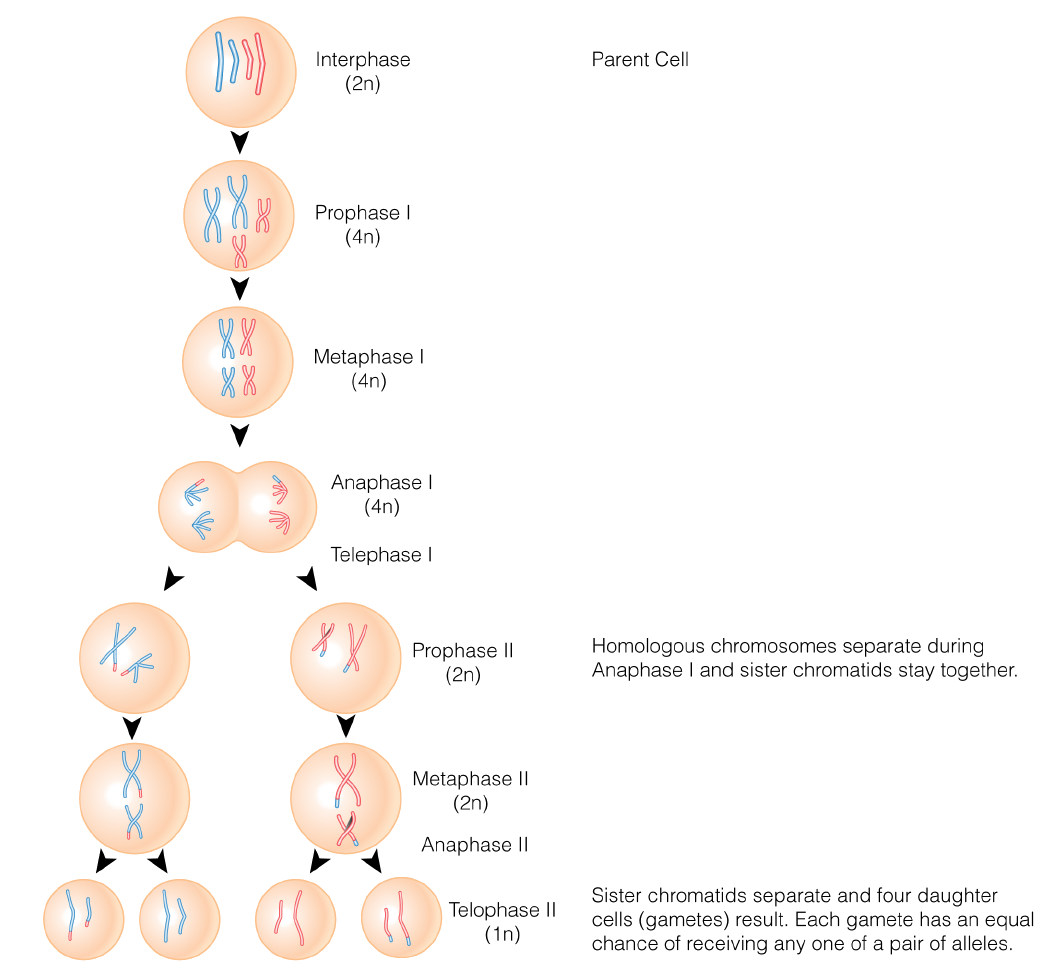
Figure 5: Alleles on homologous chromosomes are randomly separated during gamete formation. Upon fertilization, the fusion of a male and female gametes results in new combinations of alleles in the resulting zygote.
Random Segregation of Alleles
The Law of Segregation states that a pair of alleles is separated, or segregated, during the formation of gametes. During meiosis, homologous chromosomes are randomly separated. Each resulting gamete has an equal probability or chance of receiving either of the two alleles.
Mendel's Second Experiment
Mendel also crossed pea plants that differed in two characteristics, such as seed color and shape. A dihybrid cross is a cross in which the inheritance of two characteristics are tracked at the same time. The offspring of such a cross are called dihybrids. Mendel wanted to see if the inheritance of characteristics were dependent. He concluded that characteristics were inherited independently of each other.
The Law of Independent Assortment
The Law of Independent Assortment, also known as or Mendel’s Second Law, states that the inheritance of one trait will not affect the inheritance of another. Mendel concluded that different traits are inherited independently of each other, so that there is no relationship, for example, between seed color and seed shape. In modern terms, alleles of each gene separate independently during gamete formation.
Linked Genes on Chromosomes
We now know that the only alleles that are inherited independently are ones that are located far apart on a chromosome or that are on different chromosomes. There are many genes that are close together on a chromosome, and are packaged into the gametes together. Genes that are inherited in this way are called linked genes. Linked genes tend to be inherited together because they are located on the same chromosome. Genetic linkage was first discovered by the British geneticists William Bateson and Reginald Punnett shortly after Mendel’s laws were rediscovered.
Mendelian Theory and Molecular Genetics
Mendel was perhaps lucky in that the characteristics he chose to study in the pea plants had a relatively simple pattern of inheritance. These characteristics were determined by one gene for which there were exactly two alleles. One of these alleles was dominant and the other recessive. Had any of these characteristics been determined by more than one gene, he may not have been able to develop such amazing insight into inheritance. In many instances, the relationship between genes and inheritance is more complex than that which Mendel found. Nevertheless, geneticists have since found that Mendel’s findings can be applied to many organisms. For example, there are clear patterns of Mendelian inheritance in humans. Albinism (Figure 6), is a genetic disorder that is inherited as a simple Mendelian trait.
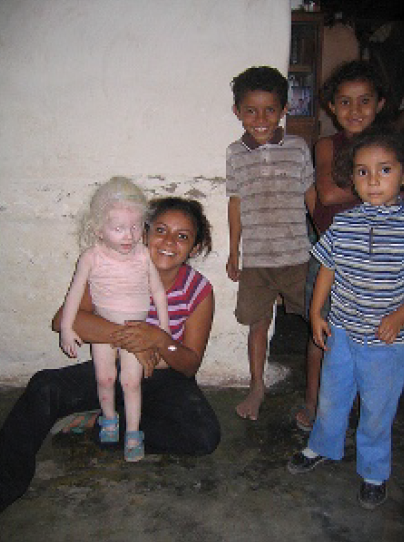
Figure 6: Albinism is a recessively inherited disorder in which the body does not produce enough of the pigment melanin. The skin, hair, and eyes of a person with albinism appear white or pale.
Dominant and Recessive Alleles
Mendel used letters to represent dominant and recessive factors. Likewise, geneticists now use letters to represent alleles. Capital letters refer to dominant alleles, and lowercase letters refer to recessive alleles. For example, the dominant allele for the trait of green pod color is indicated by G. The recessive trait of yellow pod color is indicated by g. A true-breeding plant for green pod color would have identical alleles GG in all its somatic cells. Likewise, a true-breeding plant for yellow pod color would have identical alleles gg in all of its somatic cells. During gamete formation, each gamete receives one copy of an allele. When fertilization occurs between these plants, the offspring receives two copies of the allele, one from each parent. In this case, all of the offspring would have two different alleles, Gg, one from each of its parents.
An organism that has an identical pair of alleles for a trait is called homozygous. The truebreeding parents GG and gg are homozygous for the pod color gene. Organisms that have two different alleles for a gene are called heterozygous. The offspring of the cross between the GG and gg plants are all heterozygous for the pod color gene. Due to dominance and recessiveness of alleles, an organism’s traits do not always reveal its genetics. Therefore, geneticists distinguish between an organism’s genetic makeup, called its genotype, and its physical traits, called its phenotype. For example, the GG parent and the Gg offspring have the same phenotype (green pods) but different genotypes.
Images courtesy of:
http://commons.wikimedia.org/wiki/Image:Mendel.png. Public Domain.
Bmdavll. http://en.wikipedia.org/wiki/Image:Snow_pea_flowers.jpg. GNU-FDL.
http://commons.wikimedia.org/wiki/Image:Illustration_Pisum_sativum0.jpg. Public Domain.
CK-12 Foundation. http://commons.wikimedia.org/wiki/Image: Blauwschokker_Kapucijner_rijserwt_bloem_Pisum_sativum.jpg. GNU-FDL.
Bertas la Blanquita. http://commons.wikimedia.org/wiki/File:Albino_girl_honduras.jpg. CC-BY-SA.